

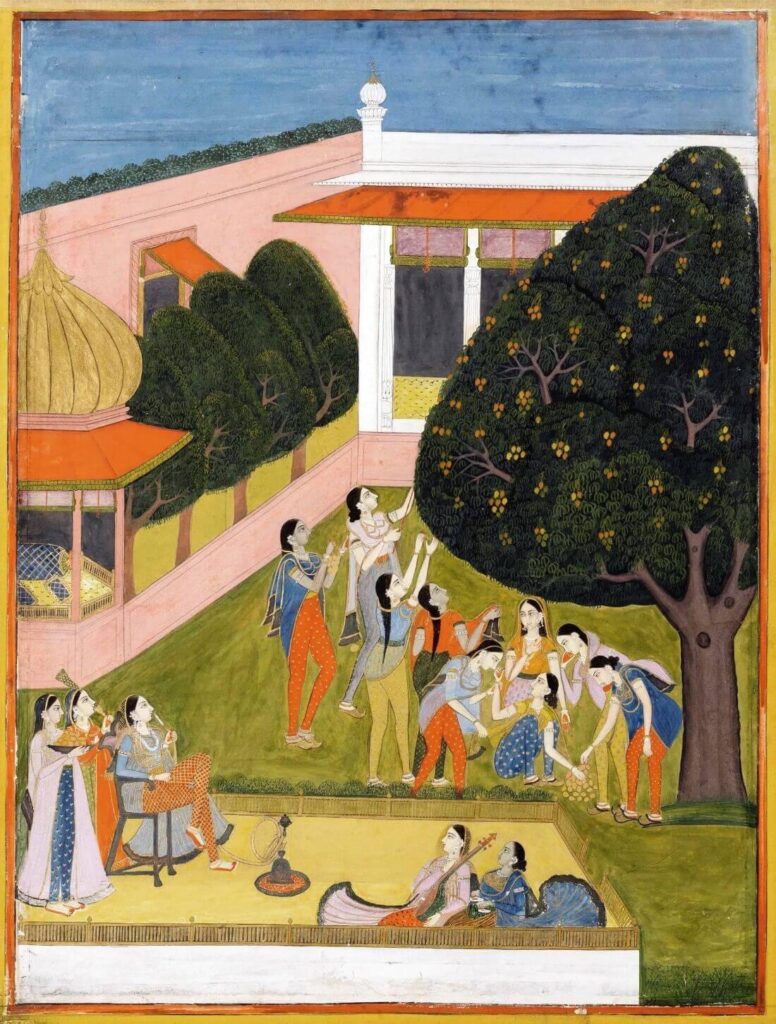
The Mango Season, circa 1760, Farrukhabad.
The mango is more than just a fruit in South Indian Literature. It is a metaphor for bodily desire, fertility, aesthetic ideals and much more. It acts as a medium of intimacy in most classical texts igniting, love, lust and desire in the hearts of lovers. This essay examines some of these instances.
The mango in Kalidasa’s “Ritusamhara”¹ embodies the sensory world of the Vasant ritu or the Spring season in its fullest. His section on the Spring season is sensual and lustful and is portrayed by the sounds and sights of the season. Mango is equated to Cupid’s arrows, as it arouses desire in the person who has inhaled its sweet, juicy aroma. This immersive, uncontrollable desire is portrayed by the male cuckoo who passionately kisses his lover on the lips and so do the bees. The mango functions like an aphrodisiac which stimulates passion in whomever takes a whiff of its scent or bites into its juicy core. In Kalidasa’s poetry, it beckons lovers to meet, and kindles suppressed desires- “The mango-trees, bent with the clusters of reddish sprouts, with (their) branches covered with blossoms and (looking) beautiful, being shaken by breezes, kindle ardent desires in women’s hearts.” These desires are often uncalled for, buried deep inside a lover’s heart, but the sweet smell of this fruit, inadvertently enraptures the senses of the passerby, and does not pay any heed to morality or decency.
Here, the mango operates not merely as an object of consumption but as an atmospheric force moving through scent, breeze, and season, entering the body before it is consciously received, collapsing the distance between the external world and internal feeling.
“Seeing the mango-trees in blossom, the traveller, wbose mental condition is distressed on account of the separation from (his) wife, shuts (his) eyes, weeps, grieves, closes his nose with the hand and laments loudly.”
It also stimulates longing for one’s lover, probably resembling their sweet smell and the comfort and familiarity that they represent in the person’s mind.
Thus, in Kalidasa, the mango does not simply awaken desire- it sustains longing, making absence palpable through sensory memory.
Jayadeva in his Gitagovindam² also equates mango-blossom arrows to that of Kama’s, piercing one’s heart with a rush of desire. Krishna while repenting his wanton ways, asks Kama to not lift his mango-blossom arrows, since he is already vulnerable and wounded by love for Radha-
Don’t lift your mango-blossom arrow! Don’t aim your bow!
Our games prove your triumph, Love. Striking weak victims is empty valor. Radha’s doe eyes broke my heart With a volley o f glances
Impelled by love-
Nothing can arouse me now!
If in Kalidasa the mango initiates desire through the environment, in Jayadeva it penetrates the body more directly. The mango-blossom arrow is no longer diffused through air and scent but becomes a concentrated force acting upon the heart. Krishna’s plea suggests that desire has already reached excess, rendering further stimulation unnecessary.
In the Amarushataka, the mango is presented as a moment of private, internal intimacy. A girl is said to be holding mango blossoms close to her as she weeps and her bosom heaves with sighs. The mango blossoms caress her gently as she cries and chokes on her tears. The blossoms grow in the courtyard where she is weeping and bees hover around them, greedy for its sweet pollen. These lines could signify her need to feel touched and embraced by her beloved, her longing for intimacy which she cannot overtly express. She is at the peak of of her youth like the sweet mango blossoms but her desires remain unfulfilled.³
Here, the mango shifts from a shared, external stimulus to an object held close to the body. Intimacy becomes interior, quiet, and restrained, it becomes less about union and more about the ache of its absence.
In the Ainkurunuru which is a part of Sangam literature 4, the scent of the mango flowers ignites a fiery passion which resembles the scent of the bodies of lovers who unite. In Sangam literature, the beauty of women is also described in terms of the mango or its leaves- ‘maanthalir meni’ or skin like tender leaves of the mango. It then goes on to say that this skin loses its luminescence and charm when she is separated from her lover. Sometimes the eyes of a woman are compared to the tender baby mango. So the mango transcends also to the territory of aesthetics.
In this context, the mango does not merely accompany the body- it becomes a language through which the body itself is imagined. Its qualities like tenderness, freshness, ripeness are transferred onto the skin, eyes, and presence of the beloved, further collapsing the boundary between nature and the human form.
In the Dashama Skandha of the Bhagavata Purana, Rukmini 5 is in pain, overwhelmed by her intense longing for Krishna and is affected by her surroundings. Even the gentle breeze, the cries of the cuckoo, the sweet words of the parrots and the moonlight agitate her. She avoids the shade of the mango trees as well, probably because even gentle and pleasant sensations become too intense for her to experience.
Here, the function of the mango is reversed. What is normally soothing and intimate becomes unbearable. The excess of longing transforms even comfort into agitation, suggesting that intimacy, when stretched to its limits, destabilizes rather than soothes.
The Kamasutra 6 mentions several concoctions that could be applied to a man’s genitals to make his wife or lover subservient to him. One of these includes a mixture of pieces of the arris root and the oil of the mango, placed for six months in a hole made in the trunk of the sisu tree, which could be applied as an ointment to the “lingam”. The portrayal of mango as a way of increasing virility is corroborated in the Charak Samhita which says that the ripe mango subdued Vata and increased semen and strength. The Kamasutra also prescribes that after a sexual union, the man should embrace his lover and give her water to drink and food as ‘sweet, pure and soft’ like a mango. Here, unlike other texts that we have discussed earlier, mango does not arouse passion or desire but instead calms and soothes one’s body after love making.
Thus, the mango extends beyond the metaphorical and enters the material body itself, no longer just evoking intimacy, but participating in it through touch, treatment, and physical experience.
In the world of Urdu poetry, it functions as a means of guilty pleasure that one could indulge in the harsh summer months. Akbar Allahbadi once dedicated a whole poem to the fruit, called Aam Nama, wherein he requested his friend to send mangoes and not mere messages. Mirza Ghalib wrote a masnavi in honour of the mango, saying that it was sent from the orchards of heaven.
ask me! for what do you know?
a mango is far sweeter than sugarcane… perhaps from the great heights above
the gardeners of heaven’s orchards have sent, by the order of God wine filled in sealed glasses
He also regretted that at his age he could devour ‘merely’ 10-12 mangoes at a sitting and not more like in his youth.
Here, the mango is no longer distant or symbolic but is eaten, consumed, and enjoyed. Intimacy becomes indulgence, collapsing entirely into the body through taste, appetite, and excess.
This is similar to the depiction of the fruit in Puranas and Upapuranas which associate it with sensory delight and as symbols of fertility and prosperity. They are presented as gifts from gods or are enjoyed by celestial beings. In both the mortal and divine realms they signify abundance and joy.
Across these texts, the mango consistently mediates intimacy in different forms- it awakens desire, sustains longing, embodies the body, overwhelms the senses, and finally becomes something that is consumed and remembered. It moves from atmosphere to touch, from distance to closeness, and from metaphor to material experience, making it one of the most potent sensory and emotional objects in South Asian literary imagination.
Endnotes
Kalidasa. The Ritu Samhara (Ṛtusaṃhāra). Translated by M. R. Kale, Motilal Banarsidass, 1996
Jayadeva, Gita Govinda, Canto I–II, trans. Barbara Stoler Miller (New York: Columbia University Press, 1977)
Amaru. Amaruśataka: A Centum of Ancient Love Lyrics of Amaruka. Edited and translated by Chintaman Ramchandra Devadhar, Motilal Banarsidass, 1984.
Ainkurunuru, in The Interior Landscape: Love Poems from a Classical Tamil Anthology, trans. A.K. Ramanujan (Bloomington: Indiana University Press, 1967).
Narasaraju, T. S. B. Dasama Skandha of Potana’s Bhagavata Purana: A Literal Translation into English (Part II). Chinmaya Mission, 2017.
Vatsyayana. The Kama Sutra of Vatsyayana. Translated by The Hindoo Kama Shastra Society, Printed for the Society of the Friends of India, 1883–1925.