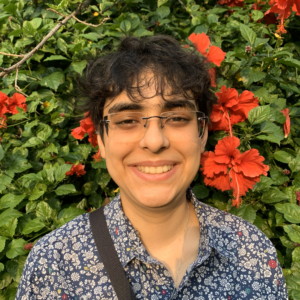

Surrounded by the glossy foliage of citrus trees, Nanabu and I sit in the garden, slitting open the skins of green chillies, thumbing out their bitter white pith. Two trays of prepared vegetables lie spread out on a cloth-covered table before us: vermillion winter carrot batons, bone-white radish sticks, white knucklebone cauliflower florets, split yellow lemons, and waxy peeled garlic cloves.
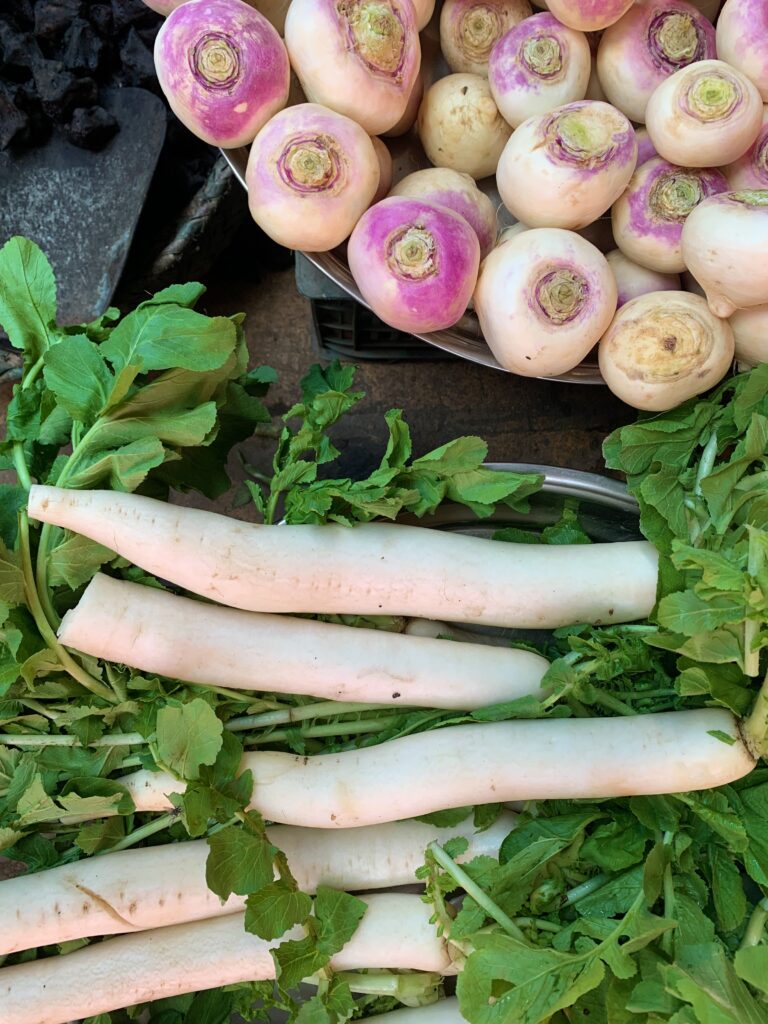
Shaljam (turnips) and mooli (daikon radish) at the vegetable market in Bani Gala, Islamabad
Just an hour ago, we had dug the root vegetables out of the bed they shared with the marigolds, gently separating them from the damp, woody earth, and washed them in icy water until my fingers were numb. It is a crisp پوہ (poh) morning – the coldest desi maheena of the year, the wheat-crop-weeding month when the land is allowed to rest.
The Sun has caused the thin mist veiling the Margalla Hills to recede, and now it dries and sterilises the produce, concentrating their flavour. I pick up a stick of deep red desi گاجر (gaajar), its slightly bitter sweetness curling my tongue before I even bite into it; I hear its satisfying snap against my teeth.
The woody scent of the masala lingers in the air: کالی رائی (kaali rai), سونف (saunf), میتھی دانہ (methi daana), کلونجی (kalonji), ہلدی (haldi), کٹی ہوئی لال مرچ (kutti hui laal mirch).. When their surface moisture dries up, we sort the لیمو (leemu), لہسن (lehsun), ہری مرچیں (hari mirchein), and مولی- گاجر- گوبھی (mooli-gaajar-gobhi) into separate steel bowls. We then plunge our bare hands into the heaps, and tenderly massage the spices and salt into the fibrous flesh, feeling the grit of the seeds against our skin. As the spices bruise, they release their volatile oils, and they enter my pores, my throat.
David Le Breton describes eating as “a total sensory act” (185). Indeed, all food-related practices are. And it is precisely this sensuousness, this multisensoriality, that makes them such intimate and erotic acts. When I make achaar, all my senses are simultaneously and constantly engaged. In the footsteps of Audre Lorde, the erotic becomes “a question of how acutely and fully we can feel in the doing” (54). In this space, in this process, I feel most acutely and fully, my senses tapping into their erotic roots, smelling and tasting and touching like never before.
 .
.
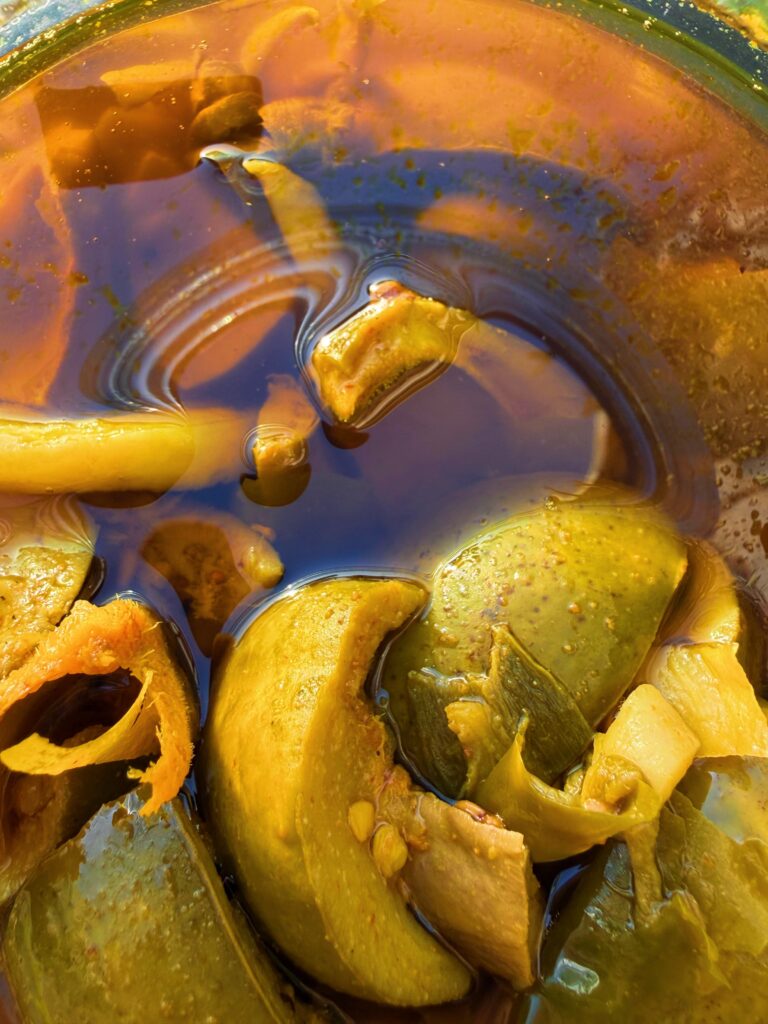
A close up of Kairi Achaar
This erotic energy heightens and intensifies these sensory experiences. I learn to detect distinct kinds of bitterness – کڑوا (karva), تلخی (talkhi), کسیلا (kasela). I feel the different acidities of lemon juice, vinegar, and chili burning my skin. I smell chlorophyll, iron, manure, decay, rot. Along with my tongue, I begin to taste with my nose, hands, and eyes. Through evoking my senses, I build up and draw from a well of embodied knowledge, nurtured by the erotic. When I experience the full depth of this presence, aliveness, clarity, and satisfaction, I begin to live from “within outward” (Lorde 58), through the extensions of myself into the lives that I inhabit. When I fully tap into the erotic roots of my senses, which I realise have been numb for so long, I experience a greater capacity to be affected by the world. The world turns into worlds.
How do we immerse ourselves in these worlds? María Lugones suggests “travelling” to them as an act of love. While she employs this as a tool to ontologically recognise different yet simultaneously existing modes of being in the socially-constructed worlds of “flesh and blood people” (9), I extend this forward into the realm of the more-than-human.
Take, for example, the world inside the achaar martabaan. Over the next few hours, the salt penetrates into the fruit-and-vegetable flesh, drawing out their water. This dehydration inhibits the growth of microorganisms dwelling on their surface, save for the salt-tolerant, halophilic Lactobacilli. Then we pack the sun-cured, now-limp produce into the glazed clay jars, firmly pressing their soft bodies down with our knuckles to push out the air. I pour warmed-and-cooled mustard oil into each martabaan, which blooms the spices as its gold fills every crevice, and its جھانجھ (jhaanjh) assertively sticks into my nostrils. Then they are sealed and placed in a patch of light to sunbathe.
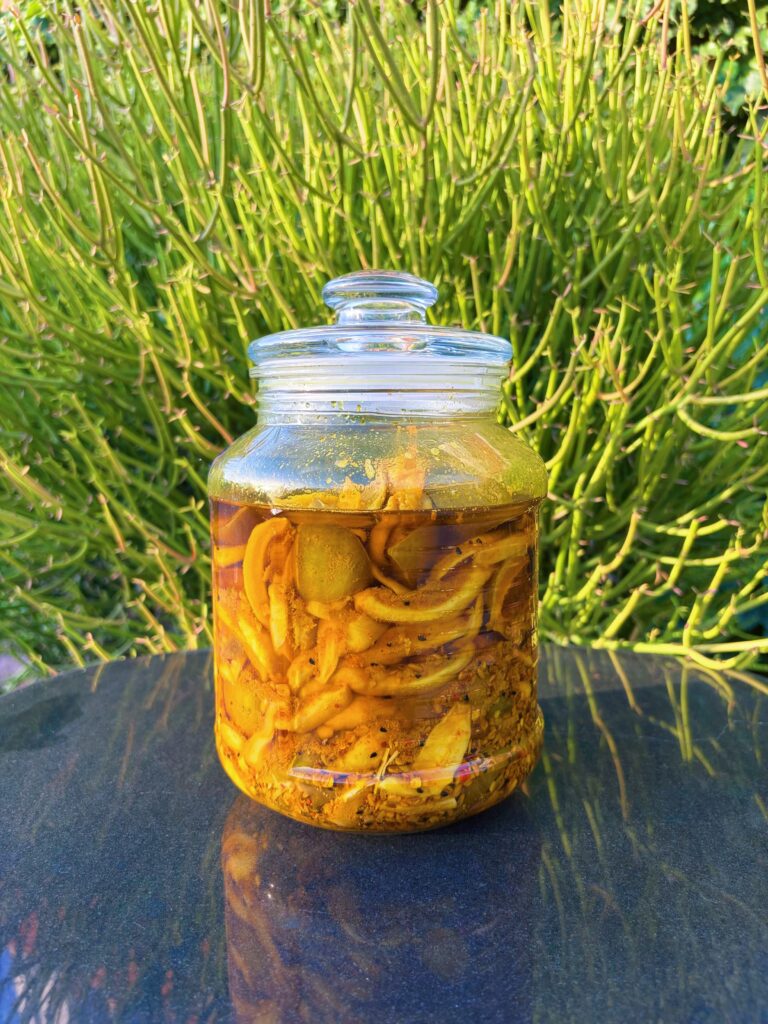 A glass jar of homemade kairi (unripe mango) achaar preserved in sarson ka teil (mustard oil)
The Sun is a primary actor during this geosocial process; its labour is crucial. Its warmth enables the spices to release their natural oils, mellowing their bitterness. It thins the mustard oil, allowing it to seep into the crisp flesh. It accelerates extraction and infusion and diffusion, turning the achaar jammy. It stimulates the Lactobacilli, which secrete lactic acid, suppressing other microorganisms that could cause it to rot, making it tangy and mouth-puckering.
This world travelling extends itself towards the work done by Elizabeth Povinelli to destabilise the binaries between life. Povinelli argues that we distinguish between Life and Nonlife, that which breathes and that which does not, through the “Carbon Imaginary” (38). This imaginary limits the loving relations we can form with the worlds around us, with the Sun which, though it does not “breathe” the way we do, is an active, autonomous agent that governs the labour of achaar-making and allows the world inside the jar, the living sustenance, to breathe. The jar can be seen as a closed, controlled ecosystem; however, it remains inextricably connected to the warmth and light of the Sun, an external entity – one we should love, not simply use. It is these species, these beings – the fruits, vegetables, spices, salt, microorganisms, water (or lack thereof), Sun – that constitute the micro lifeworld of the achaar jar. Through this co-constitution, it remains liminally suspended between freshness and decay, breathing and rotting and fermenting.
“Travelling” to multispecies, more-than-human worlds means being receptive to these encounters changing us. Lugones says this requires us to be curious and “playful” (16). When I make achaar, I try to listen and learn from my invisible kin, from subtle shifts in taste, texture, and temperature. “World-travelling” demands a vulnerability, a flexibility, an opening up of my senses that requires guidance from my erotic resources. This is what allows me to inhabit these worlds, with the understanding and acceptance that my truth and knowledge, as I know them to be, can stretch and transform and be queered by my interactions with other lifeworlds. Through this process, I begin to understand how being is always becoming, and becoming is always becoming-with.
I call this praxis “erotic world-travelling”. This epistemological and ontological reorientation provides a dynamic space for creative experimentation. Nanabu, for example, does not follow his mother’s recipes; he crafts his own, constantly adjusting for his personal palate, and the varying sweetness/bitterness and availability of ingredients in Islamabad. In the same vein, I do not necessarily follow his recipes either: he likes boiling his spices in water, I prefer blooming them in oil; he skips the suncuring step, I synchronise my fermenting with the sunlight; he believes مولی (mooli) and شلجم (shaljam) are too watery to make good achaar, I adjust my methods in an attempt to include them. We banter, argue, bounce ideas off each other (“Why can’t we make achaar with kinnow if we make it with leemu?”). I go with him to the market, asking him about ingredients I have never used before, purchasing them to turn them into permutations of achaar that completely flip his paradigm of what it means. Ultimately, we both follow our own erotic guides, whose heightened sensory demands push us to create, rather than replicate. And sometimes, my achaar turns mouldy, cloudy, slimy. However, my fear of failure is eclipsed by my desire for a deeper, more vibrant connection with the world. Perhaps my sensory knowledge grows deeper, but I also learn that to truly experience joy, I need to accept the risk of the rot. Intimacy demands having the space to fuck up. As my erotic compass is constantly recalibrated, my (re)imaginations are rearticulated.
Often described as a “labour of love”, achaar-making is a deeply gendered activity that has been historically consigned to the domestic, feminine space in the Indian subcontinent. Nanabu witnessed his mother and the other women in the village of Qazi Karam Shah, Gujrat make large batches of achaar with کیریاں (kairiyaan), ہری مرچیں (hari mirchein), آملے (aamle), لسوڑے (lasoore), and سوہانجنے کی مولیاں (sohanjnay ki mooliyaan). In households where saalan was made once a week, these achaars formed an integral part of starch-rich staple diets. He often saw the village women going out at midday to give their husbands – who worked a few kilometres away in the fields – their meals of ghee waali roti, achaar, and buttermilk lassi. Some of this produce, part of the wild flora of the highly agriculturised Chenab River plains, only came for brief pockets of time. Often bitter, slimy, and astringent, the achaar-making process turned these hyperseasonal ingredients into bright, tender, tangy ferments that were preserved and consumed for months, over seasons.
Making achaar allows Nanabu to reexperience the flavours of his childhood diet – one he describes as “simple”, “nourishing”, and “good for the gut”, and one that he witnessed those around him consume. He becomes the medium through which the labour of his mother, and the women he grew up around, continues. His embodied memory becomes the erotic bridge to these feminine worlds and temporalities. When he inhales the pungent scents, he lives in the sensory world of these women, remaking kinship across the barrier of death and time. In the process of achaar-making, time itself becomes suspended, thick, relying on cyclical, elemental ebbs and flows rather than chronological clock-time. The slow, unhurried pace of this “queer” time is its own form of desire – an appetite that waits for the becoming of the achaar, rather than its immediate consumption. So I recalibrate my internal clock, and we wait for the spices to mellow, for the flesh to sour, for the achaar to transform into a source of nourishment, satiety, and living energy.
Erotic world-travelling forms a bridge between Nanabu and I in our shared pursuit to satisfy our desires for taste, for sensory experience, for the world. Our differences, the lived years between us, the diverging worlds we inhabit, dissipate in the garden where we ferment. We bond over this shared emotional and intellectual joy to make something to satisfy our suppressed appetites. It is an intimacy of spirit and labour, a psychic and emotional resonance, a collaboration between different worlds and scales of life. One that connects me to him, him to me, him to his mother and I to her, to ancestors I have never crossed paths with before, and now onwards to friends and lovers I cook with, eat with, and feed food that affirms and sustains life.
When I taste the gaajar ka achaar a week later, a constellation of sweet, salty, spicy, sour, and bitter flavours commingle on my tongue. However, I do not just consume fleshy vegetables, but the Lactobacilli that give it its unique taste, and the corpses of those bacteria that died in the salty sun-pickling process. These will enter my intestines, becoming a part of my gut microbiome. My “trans-corporeal” (Alaimo 238) body crosses through, transforms, and is transformed by other beings in dynamic, overlapping worlds. The evidence of this is the haldi that clings to my skin, my cuticles – stubborn ochre stains that have survived multiple washes, even following me into my dreams.
As is evident, eating is an inherently intimate act because it is how we literally consume the environment, how it steps into our bodies. This is how we integrate the Other into our flesh, bones, and blood. The erotic becomes an act of incorporation, of mutual embodiment between beings. Through eating, the boundary between the Self and the World, or Worlds, dissolves, undoing any notion of separate self-containedness.

Cutting desi gaajar (carrots) for mixed achaar.