

Forbidden Desire on a Plate of Macher Jhol and Bhaat
- Mohua Chinappa
It was siesta hour, and the house grew quiet in the sultry summer of Kolkata. The slatted windows were closed to block out the intense sunlight from entering the large home. This was an old zamindari house with big verandas and marble topped tables, the edges hanging like shame of a debauched history of entitlement and humiliation etched into the Belgian glass mirrors.
Romila knew it was around this time that her daughter’s young tuition teacher would arrive for class. She kept the side table lamp on, trying to create a comforting atmosphere in her neat, tidy home. The light cast shadows on the red oxide floor, which needed repair.
The tuition teacher was Obhiroop, 24 years old, from a small town far from the city. There was sincerity in his demeanour that made others feel at ease in his presence.
His youthful energy was evident as he climbed the winding staircase. His lean body was visible through his white shirt, the belt cinching his narrow waist over his ill-fitting blue trousers.
Obhiroop Mukherjee wasn’t aware that he was handsome with a strong jawline, short beard, wheatish skin, and artful hands that seemed made for painting. His deep-set eyes carried a quiet, thoughtful expression.
Romila Sen was 42. The workers at home called her Boudi, the one who always knew where the missing vegetable bills were. She was in charge of this dilapidated mansion that held little value. Romila had spent years putting this home together, despite the creaking beds and tree branches growing from the walls. She hadn’t realized where time had flown, and now, after watching Obhiroop’s agility, she thought about her youth and felt it had passed her by. She had married young and was shy about discussing her hopes and desires with her husband, topics women from good families didn’t usually talk about.
Now, Romila’s lower abdomen bore the marks of pregnancy, and her breasts, when she bent down, looked like bananas as she picked up vegetable peels from the cold kitchen floor. She sometimes felt disconnected from her own body, ashamed of her nudity, and rarely looked at herself.
Obhiroop arrived today earlier than usual, sweat staining his shirt’s armpits from the hot summer. He turned on the fan and unbuttoned his shirt to cool down. Romila offered him water, but he politely declined, modest about his background and unwilling to seem presumptuous. She felt gentle tenderness toward him and asked, “Have you eaten lunch?” He smiled softly and replied, “No, I came directly from the pharmacy where I work.”
Romila expressed concern about his difficult life and invited him to join her for lunch. Though hesitant at first, he agreed. She led him into the dining room, where the midday sun shone fiercely. Outside, stray dogs rested beneath neem trees; rickshaw pullers, covered with towels, also sought relief. She set two brass plates for them.
She served Obhiroop rice with a slice of lemon, green chili, and salt on the side, then arranged other dishes in bowls: hyacinth leaves, dal, and fish curry. As he washed his hands, he looked up at Romila, her cheeks flushing slightly as she noticed his grateful, gentle gaze. They began to eat quietly. Obhiroop was a peaceful presence, unlike the others at home. Romila savoured a piece of fish, sucking the bones and licking her fingers and lips with curry seasoned with nigella seeds. He noticed her bowl had little gravy. Softly, he asked, “Why did you give me two pieces of fish with extra potatoes? Won’t you share?”
She was taken aback, unsure how to respond to this quiet intimacy on a summer noon, an intimacy she hadn’t experienced in years. A warmth spread through her, as if someone had touched her for the first time. Obhiroop gently got up, leaving half a fish and a piece of potato, and softly said, “It’s no fun if I don’t share and watch your passion for the fish.”
Romila brushed a strand of hair from her face and quietly accepted her food. She wondered if he would return for his next lesson or if another summer noon would find them both sleeping in their separate worlds, connected only by the unspoken longing between their plates.
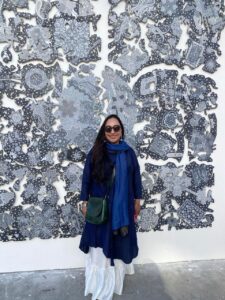
- Mohua Chinappa
Mohua Chinappa is an author, a columnist, a renowned podcaster in India, a TEDx speaker, a former journalist and a corporate communications specialist. The Mohua Show, a podcast she started in 2020, has close to 2 million downloads. She contributes regularly to various national dailies and magazines, including The Telegraph, Deccan Herald and Outlook. She is regularly invited as a speaker on TEDx and Josh Talks. Mohua’s other initiative—NARI: The Homemakers Community—provides a platform for homemakers to voice their everyday challenges. Her book—Nautanki Saala and Other Stories—was awarded the PVLF Best Debut Non-Fiction (in English) Award 2023. She also has two poetry collections to her credit—If Only It Were Spring Everyday and Dragonflies of My Dreams.