

I begin with a recipe I can only remember in parts.
Not because it was never taught to me, but because it was never meant to be written down. It lived in my mother’s hands, in the way she put the curry leaves, in the pauses between stirring, in the instinct to taste and adjust without measuring. I have been trying to return to it for years now, not just to cook it, but to understand what it held together.
My name is Vamsi, an interdisciplinary theatre artist, my work explores autobiography, caste, anti-caste practices, and lately food. In my work Come Eat With Me (CEWM), I trace the relationship between caste and food, how it travels through bodies, histories, and silences. My mother’s chicken curry is an important character in my piece, the show concludes with audiences feasting on it. Along the way, it became more than just a dish. It became an archive, a witness, a way of telling, a way of connecting.
This essay is part of my current practice, to understand recipes, recipe writing and their relationship with the “I” & the “We”.
I am trying to find the recipe. Again.
What I have, for now, are a handful of stories I return to in my performance, not only to speak about caste, but to trace my own relationship with this chicken curry. I have told them at nearly fifty shows, and each telling loosens something. A memory surfaces, always in fragments.
Just when I begin to feel close to the recipe, it slips away. What I am left with is not a list of ingredients, but a trail of people it fed, spaces it entered, intimacies it made possible, and the ones it could not hold.
I will speak in the first person. There will be many “I”s. Stay with me.
What follows are four memory vignettes. Each one a different moment, a different body, a different table. In each, the recipe appears and disappears, sometimes as food, sometimes as gestures, sometimes as questions. Through them, I try to understand how I have fed others, how I have fed myself, and what it means to build intimacy through something as ordinary, and as charged, as a meal.
I don’t know where this will lead me; each time a story surfaces, it either reveals something I hadn’t known about myself or leaves behind an ache that points to what was lost.
I am beginning to suspect that what I am really looking for is a language that can hold hunger, care, caste, desire, and the fragile, fleeting ways we share intimacy.
This is that attempt.
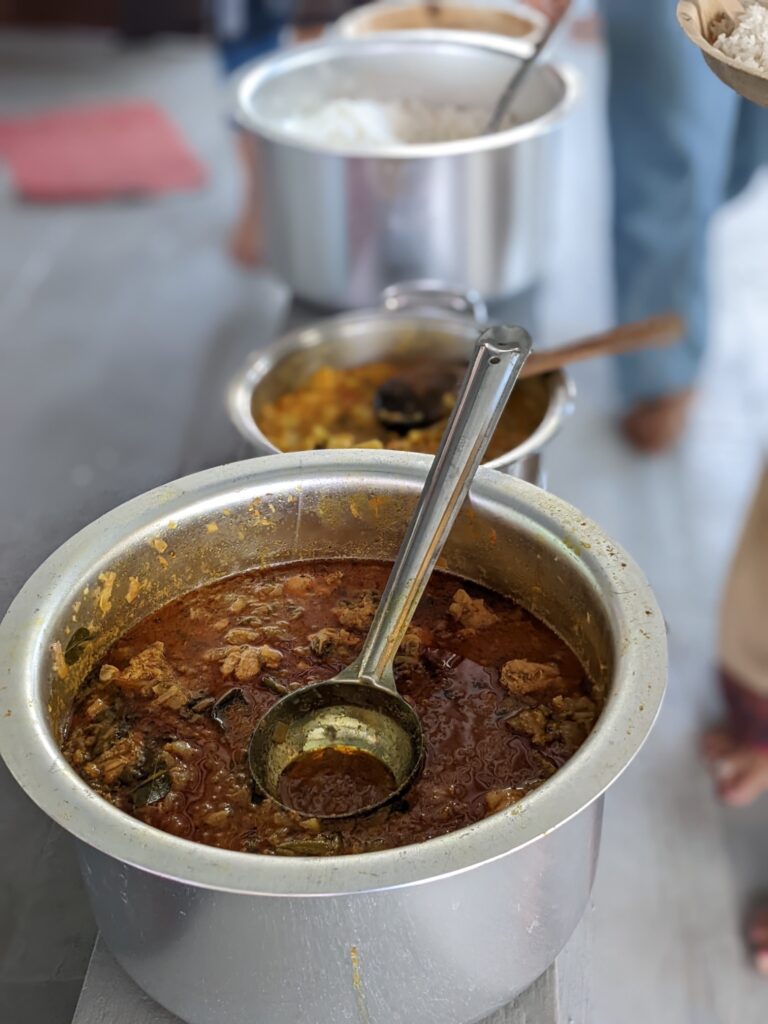
Ammulu Gari Kodi Kura, CEWM show, Bangalore, 11 June, 2022. Photo by Apeksha Vora
Memory vignette no. 1; circa 1997
I have been trying to return to this moment for almost six years now, especially in the lead-up to the first sharing of CEWM. It is a story I tell about eating my favourite chicken curry. Even now, it arrives only in parts. Ammulu’s Chicken Curry. Ammulu is what everyone calls my mother at home. Somewhere in my journey toward assertion and self-determination, I did not call the curry after a place or technique, and simply named it after her. My mother was a working woman, a doctor in a government hospital, which meant Saturdays were days and sometimes even night shifts. For my four-year-old brain, it meant disappearance. I did not yet have the language for shifts, schedules, labour. Only absence and return.
So some Sunday mornings, I remember waking up to a smell I could not yet name, but my body understood before I did. Something in my nose registering pleasure for the first time, sending signals, something good is coming, be ready. My mouth watered before I knew why. I walked into the kitchen, there she was. The person who had been missing last night was now standing over a stove, cooking up a feast.
And then she fed me.
The kind of care that I did not recognize then, but my body stored it anyway. The taste, the heat, the texture, being fed, it settled somewhere deep, became a core memory without announcing itself as one. Now, when I eat this curry, that is what returns. Not technique, not ingredients. Just that feeling. Even now, carrying the grief of her absence, of her passing, this curry does something else. It lifts me up like a fast-paced SPB song, like a Johnny Lever well-timed joke that lands, like a hug from my lover that arrives before you ask for it. I always remember how I finish my chicken curry, I lick my finger clean.
It moves through me without effort. And in that moment, it is only love.
Memory vignette no. 2; circa 2012
Fresh out of home, I arrived in Bangalore for my undergraduate degree, my first real encounter with independence, or something like that. The campus I lived in had its own grammar of belonging. The naive me, believed everyone there knew how to be, what to say, how to carry themselves, what counted as interesting, as intelligent and as worth noticing.
I was trying to learn all of it on the go.
I wanted to be someone people turned to, easy, funny, present, in the right room, someone who couldn’t be ignored. I told myself it was ambition. But looking back, I can see the fear sitting underneath it. A quiet anxiety that if I wasn’t enough in visible ways, something else would define me. That I would be reduced to a single word, a single category; “reserved category”. That my caste would precede everything else. That I didn’t really belong, only allowed in.
So I performed ‘belonging’ before it could be taken away.
I tried to stand out so I wouldn’t be looked at too closely. I tried to be wanted so I wouldn’t have to confront the possibility of being excluded. And in that effort, I kept moving, talking, joking, showing up, rarely pausing to ask what it was doing to me, or where that need was coming from.
One of the ways I learned to belong on campus was through food. I would take people around the city, make them try things they hadn’t eaten before, stretch my scholarship just enough to afford these small acts of hosting. It felt like a way in, into conversations, into friendships, into being seen. Somewhere in that phase, I discovered KFC hot wings.
And with me was N (name changed), a Madhva Brahmin boy, from South Bangalore. He was curious, wanted to transgress, he wanted to try things he hadn’t grown up eating, things that sat outside his family’s idea of purity. So we… I made him try the KFC hotwings. He lost it. I mean, fried chicken will do that to you.
I remember telling him, almost instinctively, “If you think this is best, you should eat my mom’s chicken curry.” And now he wanted to taste it. I wanted him to. Not just because I believed it was better, I also wanted to be the person who could deliver something that good. Something that came from where I came from.
The problem was, my mother was in Visakhapatnam. There was no immediate way to make this happen. So I decided I would cook it. I didn’t really know how. I had fragments, watching her, tasting it, remembering textures. This was also my first time having access to the internet, not fully knowing what it could do for me. Recipes existed there, but none of them were hers. So I did the usual thing. I called her. It was one of our usual post-dinner calls. We had them almost every day.
“Amma, can you give me your chicken curry recipe?”
“Why?”
“I want to make it for a friend.”
A pause.
“You went there to study, not to cook.”
That was it. A firm final. Carrying a year’s worth of worry about what I was doing with my newfound independence.
The conversation stopped there. But I held on to what I could. Between memory and guesswork, I pieced together maybe eighty percent of the recipe.
Then an opportunity came. N told me his mother was travelling, empty house. We could cook there. I went to Yeshwantpur to buy everything: chicken, onions, masala, oil, things needed and then to his house in Basavanagudi. His mother’s kitchen. Her vessels.
I made white rice in an electric cooker. The chicken curry in a pressure cooker.
We ate. He licked his fingers clean. Nothing left behind. I did it, delivered on the promise. Now cleaning up, the bones and waste went into a black garbage bag.
Then he asked me to wash the dishes. All of them, the ones we both ate from, plates, spoons, vessels, all of them..I didn’t think twice. It felt like a continuation of the same act. I had cooked, we had eaten together. So I washed everything. No hesitation. Because what mattered then was that I showed up, I delivered.
I didn’t return to this memory for a long time.
Not until I began working on CEWM. And then it came back, differently.
The question arrived late, almost casually, why did I have to wash the dishes? We had both eaten. But now, touching them has shifted into something else. This is not an accusation, I don’t think he knew what he was asking.
But the memory sits differently now. The intimacy I thought we shared feels altered when placed against the history of caste we both carry. It’s not a loud hurt. Not even a clear one. More like a hesitation, a second-guessing, am I reading too much into it?
A familiar feeling, the body unpacking caste after the moment has passed.
The first time I cooked this curry, I thought I was recreating a taste, but something else stayed.
I carry an identity.
And the food I make carries it too.
Memory vignette no. 3; circa 2016
By now, I was making this curry whenever an opportunity presented itself. It was practical. One kilo chicken could feed four people, sometimes more. It didn’t cost much. And in return, it gave something that felt larger than the sum of its ingredients. It kept people around the table a little longer. As friends moved into rented houses across Bangalore and began hosting small parties, Ammulu’s chicken curry became my offering. My party trick.
Mostly it was bachelor boys, living on pizza, maggi, or takeout routines that never ended. They would watch me cook with fascination. Then they would eat, surprised, by the effort, by the taste, by something that felt like “home”. These boys working in multinational companies, earning more than a lakh per month, sitting there in quiet awe of a three-hundred-rupee chicken curry.
It did something to me.
I felt invincible.
I had found a way to create intimacy on my own terms. To host, to offer, to be needed. I was still on campus then, trying to finish a four-year degree that had already stretched into a fifth year. I didn’t yet know it would take longer. But in these moments, that didn’t matter. Here, I knew exactly who I was. I was the one who cooked. I am getting ahead of myself. What I want to say is, this intimacy, for a long time, was also a kind of negotiation. I was still building something, still trying to hold my place in rooms where belonging didn’t come easily. Cooking helped, it translated me.
Something changed.
There were a group of my juniors on campus, Telugu boys, from places not too far from where I came from. They had been hearing about this chicken curry for a while. One day they asked me, “Vamsi, if we get all the ingredients, a stove, vessels, will you make it for us?”
I was already close to them. Not just as a senior, but as someone they spoke to easily, like an older brother. That relationship has stayed, even now.
I said yes.
They were excited in a way that felt different. Not curious, not performative, just a genuine desire to eat something better than what the cafeteria offered, something that felt like theirs. They arranged everything in one of their rooms. Chicken cleaned, vegetables chopped, masalas ready. When I arrived, all I had to do was cook.
So I did.
They ate with a kind of ease I hadn’t noticed before. Hands going back into the curry, plates wiped clean, conversation flowing without interruption, fingers licked clean.
And when we were done, they stopped me from getting up.
“You’ve done all the work,” they said. “Let us clean.”
They gathered the plates, washed the vessels, wiped the space down. I watched.
Something shifted in me then. A different kind of intimacy took shape, one that wasn’t about proving myself, or earning a place, or accumulating some invisible social capital. It felt quieter, settled. This was not about being impressive. This was about being held in return. For the first time, I felt like I wasn’t cooking to be seen. I was cooking to nourish and being nourished back. Not just through food, but through the way care moved between us, without negotiation. In that moment, I could feel something else too. As if my mother, my grandmothers, who had fed people long before I knew what that meant were present in the room. Not as a memory, as pride.
Memory vignette no. 4; circa March, 2023
CEWM had begun to travel. I was invited to perform at Lamakaan in Hyderabad for their 13th anniversary. My first time performing in a Telugu-speaking city. It felt like a return, and a test. This would be my tenth show, and the largest yet,cooking for nearly 150 people, with help from the lamakaan café staff. I was excited, rehearsing, packing, imagining the scale of it. In the middle of this, a friend texted:
“Do you want me to invite Gaddar for your show?”
My body went into a kind of slow panic.
Gaddar – Gummadi Vittal Rao, a poet, singer, revolutionary. His songs were everywhere growing up. His performances were legendary, he was a household name, in the way SPB was. Gaddar could mean many things to many people, but for me, he was the embodiment of cultural revolution. If you attend my show you would know, the show ends with my mother’s chicken curry and it begins with Gaddar’s songs. His voice holds the political and emotional ground on which I stand.
I said no. I didn’t think I could perform in front of him. A few days passed. The no began to feel like a mistake. I asked my friend to invite him. He said yes. Now I was terrified.
On the day of the show, just as I was preparing to start cooking, I got a message: he wouldn’t be able to make it. Meetings all day. I felt a brief disappointment, followed by relief. Maybe it was better this way.
Around 5 pm, while setting up the performance space, someone walked up to me and said, “Anna is here. Where should he sit? Can we get him some chai?”
“Who anna?” I asked, turning.
And there he was. Walking towards me. Gaddar.
Everything after that blurred a little. I ran to my brother, who was helping with production. We panic-geeked for a moment, then gathered ourselves, arranged a place for him, and began the show.
He sat right there. As I performed, he hummed along to his own songs. Softly. Almost to himself. It felt unreal, like the performance had folded in on itself. He stayed till the end.
And then he stayed to eat Ammulu’s chicken curry. My friend nudged me. I should go speak to him. I would have been happy with an autograph, I sat down beside him as he ate.
He licked his fingers clean. We spoke. Or rather, he spoke and I listened, holding on to every word. It felt strangely intimate, like the space had narrowed to just the two of us. He, eating the food I had made. Me, trying to stay present in a moment I knew I wouldn’t fully grasp until later. As he was leaving, we took photos. And then he said something I will carry for the rest of my life:
“Bidda, next time you perform, don’t play my songs on a speaker. Tell me. I will come and sing for your show.”
What else a boy could dream of. That was the first and last time I met him. He left us that next year.
But that image remains, him sitting there, eating my food, speaking to me.
An intimacy I did not know how to ask for.
One that arrived, and stayed.
____________________________
I have performed CEWM close to fifty times now, across cities, rooms, and audiences that shift each night. And still, I find myself asking, what else can this recipe teach me?
Each telling rearranges it, adds something, takes something away.
What I have now is not the original recipe. I am no longer sure that ever existed in the way I imagined it. What I have instead is an accumulation, a practice shaped by every time I have cooked, fed, been fed, reached for someone, or been held in return.
This recipe has become that.
A way of gathering intimacies across time and space. Not seamless, not neat, but held. It holds my attempts at belonging, my negotiations with caste, my desire to be seen, my fear of being reduced, my grief, my small joys, my inheritances. It holds my mother, even in her absence. It holds the people who have sat across from me and eaten what I made, what they took from it, and what they left behind.
I began by searching for a recipe. What I found, instead, was a language.
Not one that explains intimacy, but one that practices it, through gesture, through labour, through offering. A language that doesn’t always translate cleanly, that carries residue, that falters, that returns.
I am still learning how to speak it. One chicken curry at a time.