

I
The weather app warned that the evening would be muggy—a word that never quite captures the feeling of being slowly steamed, as if one were a batch of potatoes left too long in a covered pot. A kalboisakhi had tried and failed to arrive. The wind had risen, the clouds had grumbled, but some miscalculation of pressure or temperature had denied Kolkata its evening storm. The city lay in a state of atmospheric indecision, and the air grew thick, clinging, irritable.
I went out for a walk anyway. The heat made me hungry—hungry for food, but also for human voices. The quickest way to both was the phuchka stall near my home. By the time I reached it, a small constellation had already formed around the vendor, Rajat dada. I joined the circle, sal leaf bowl in hand, one among nine.
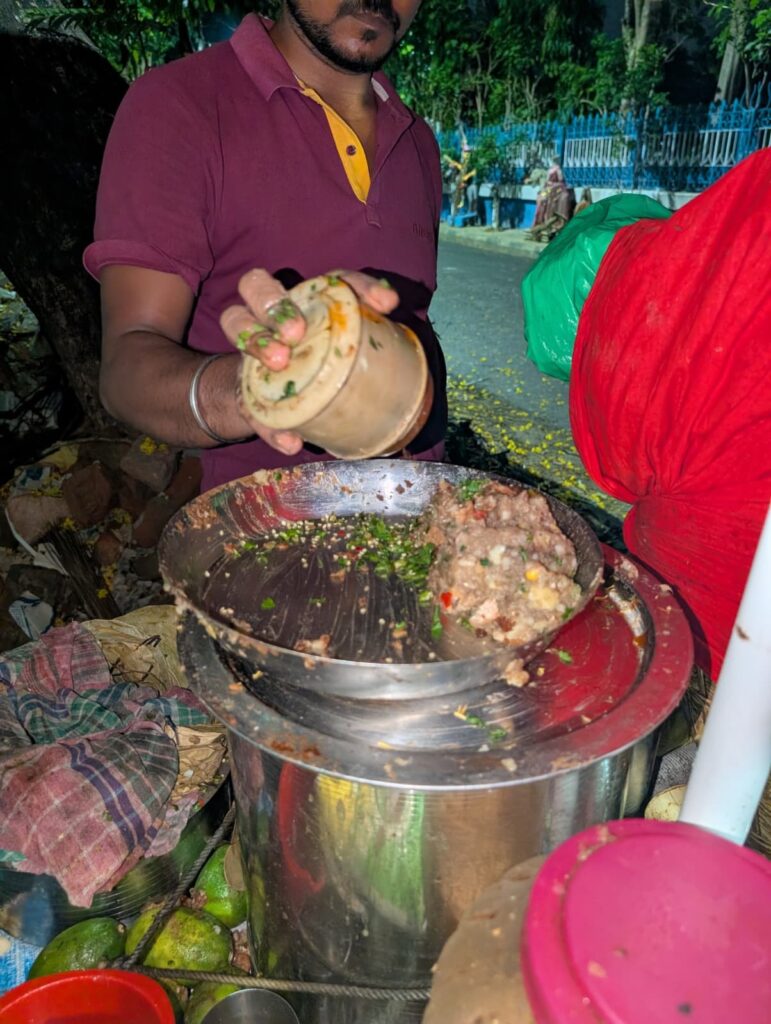
There were three women who worked as housemaids in my neighbour’s home; a mother and her son, both bent under the weight of their bags; two college students returning from their part-time jobs; and a man clutching a tiffin box. We stood around the stall in an uneven ring, each holding out our bowls, each waiting for our turn. The wait was not patient. It was a tense anticipation of not being able to finish the last phuchka before the next one arrived, because the rate at which we chewed and gulped was often outpaced by the rate at which Rajat dada’s hands moved. Tamarind water splashed, potatoes were stuffed, chillies were crushed; mouths burned, eyes watered, hands reached out again.
It was here, in this circle, that I became privy to an escape being planned.
The two college students had chosen the phuchka stand as a place they could meet without arousing suspicion. They were not lovers themselves. The man, Akash, was helping the woman, Rita, flee with her lover, Sharmila. (Names changed.) This very stall, I gathered from their hurried conversation between mouthfuls, had once been Rita and Sharmila’s meeting place. “Where else can I wipe the excess tamarind water off her lips without raising an eyebrow?” Rita said, half-laughing, half-remembering.
Things had been fine until Rita’s mother discovered her WhatsApp chats with Sharmila. She had shown them to her husband dutifully, who had responded with the familiar repertoire of paternal authority, dutifully: forbidding Rita from going out with Sharmila, threatening an early marriage. The phuchka stall, which had once sheltered their intimacy in plain sight, now became the staging ground for an escape. They discussed routes, timings, excuses—all in muffled words, because their mouths were never empty. By the twentieth phuchka, the plan was set. They wiped their hands, adjusted their bags, and walked away.
I remained, internally thrilled and anxious, wondering if the plan would succeed and what other stories this stall had silently witnessed. By the time I finished eating, I was sweating from the weather and from the profusion of chillies coursing through my system. I found myself asking: what is it about this food that made me choose it over something cooling on such an evening? And what is it about this particular space—a few square feet of pavement, a man with a pot, a circle of strangers—that allows such a democratic intimacy in public?
This essay is an attempt to answer those questions. I argue that the phuchka stall in Kolkata functions as a small, fragile experiment in equality: a liminal urban space where gendered and classed hierarchies seem to loosen for a moment, even as they never fully disappear.
II
In the film, Rab Ne Bana Di Jodi, one of the first moments of ease between Taani and Raj unfolds not in a restaurant or a park, but at a phuchka stall. They engage in a phuchka-eating competition, tears streaming, tamarind water and crumbs falling everywhere. The choice of location is not incidental. A restaurant would have suggested a formal date, a courtship with all its scripted expectations. The stall, by contrast, is public, noisy, and low-stakes. In the guise of a playful contest, they are allowed to be messy, vulnerable, and unguarded in front of each other.
Bollywood often frames street food like this—as a first-date idea that is fun, casual, and accessible. This representation both emerges from and feeds into our social imagination: the phuchka stall as a place where one can test a connection without declaring it. Rita and Sharmila’s story sits within this cultural script, but with higher stakes. For them, the stall is not just a cute backdrop; it is a camouflage, a place where a gesture like wiping tamarind water from someone’s lips can pass as ordinary, because the whole scene is already saturated with touch, mess, and proximity. Their desire has to hide in plain sight.
If popular cinema casts the phuchka stall as a site of playful, heteronormative romance, my memories of it are more entangled with women’s constrained freedoms.
Soma aunty, my school friend’s mother, loved bringing phuchka or papri chaat for us during group study sessions at her home. On other days, my friend would say, “Today is Saturday—when Ma goes out for her weekly phuchka, I’ll ask her to buy me a pen.” The phrasing stuck with me: not “if she goes,” but “when she goes.” The weekly outing to the phuchka stall was a fixed point in her week, a small ritual of leisure.
Later, I learned more about Soma aunty. She had been married before she completed her tenth standard, a decision shaped by financial difficulty and family pressure. In a family of academics and doctors, this early marriage marked her as someone whose formal education had been cut short. For her, going out in the evening was never a simple matter of stepping out. It required a reason that could be defended, a purpose that fit within the patriarchal calculus of legitimacy. A three-minute walk to the phuchka stall after a day’s labour made sense. It was a brief indulgence, a reward, not a claim to unstructured time.
That short walk offered her fresh air, the flicker of streetlights, the soundscape of vendors and vehicles, and a few minutes of conversation—“gossip,” as it would be dismissed. The phuchka stall became a form of feminine leisure that could be justified: quick, near home, framed as a small treat rather than a demand for space. It was a way of being out without having to explain why.
In the mind of many middle-class Kolkata dwellers I have known, there is a familiar dichotomy between gossip and serious conversation, mapped onto two different stalls. The tea stall is for men: they lean on counters, sit on benches, and stretch time with their cups, discussing politics, cricket, neighbourhood disputes. The loud slurp of tea is part of the performance of seriousness. The phuchka stall, by contrast, is often coded as a space of small talk—what the maid cooked, whose son got an A+, the delays in ration, the rising price of onions. Men come here too, of course, but they rarely linger in the same way. The tempo of the stall—the quick stuffing, the rapid serving, the burning mouth—discourages long debates. To engage in this kind of talk, to dwell in this kind of space, might feel to some men like a softening of their masculinity.
If the tea stall is about duration and the consolidation of bonds within existing hierarchies, the phuchka stall is about brevity and circulation. It is not designed for a two-hour adda. It is designed for the quick satisfaction of a craving, the swift exchange of words, the rapid turnover of bodies. This very quickness is what makes it legitimate for women like Soma aunty: it is leisure that does not dare to take too much time, space or money.
Yet within this brevity, something else happens. The phuchka stall becomes a place where women can stand in public without needing a more respectable pretext, where queer couples can meet under the cover of a crowd, where domestic workers and employers might find themselves side by side, hands outstretched toward the same pot. It is here that the question of liminality arises.
III
Cultural anthropologist, Victor Turner describes liminality as the “betwixt and between” phase in ritual processes, a threshold where normal social statuses are temporarily suspended. In such moments, he argues, a communitas can emerge: an unstructured, egalitarian bond among those who share the liminal experience. (Tuner 95)
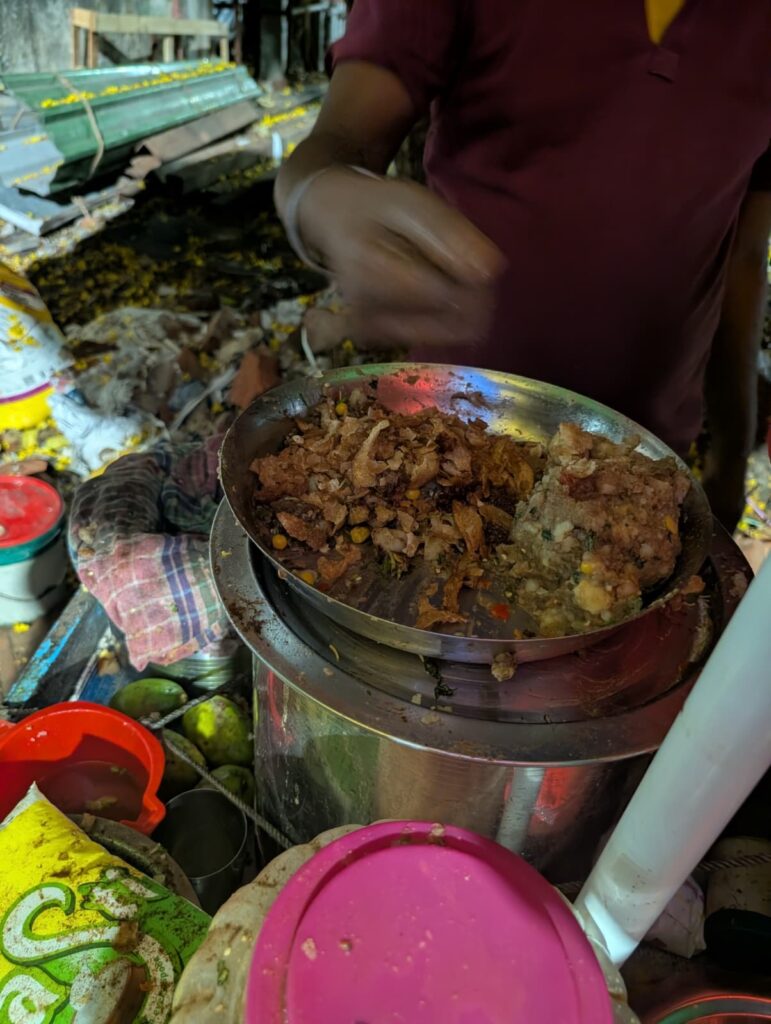
A phuchka stall in Kolkata is not a ritual site in Turner’s sense. It is an everyday urban space, a piece of pavement. Yet it behaves like a threshold. People arrive from different homes and destinations, pause here, and then disperse. They form a loose circle around the vendor, not a queue sorted by age, income, or gender. The rule that governs the stall is simple and visible: first-come-first-serve. Rajat dada’s hands move in a steady rhythm, filling one puri after another, extending his arm in the direction of the next waiting bowl, without apparent favouritism. A shiny note does not get priority over a crumpled one; both promise to pay the same amount, and both are accepted.
In this circle, there is a shared vulnerability. Everyone eats messily. Tamarind water drips down wrists, chillies sting tongues, eyes water, noses run. There is no graceful way to eat a phuchka. The very act of consumption levels us, if only in how ridiculous we look. For a brief moment, we are all reduced to mouths and hands and the urgent need to cool the burn with the next bite. It is tempting to see this as a small communitas: a fleeting suspension of social status, an egalitarian choreography of reaching and receiving. But the story of Anima didi complicates this temptation.
Anima works as a cook in my mother’s home. She often talks about “equal treatment.” Compared to some of her colleagues, she considers herself fortunate: in our home, she can sit on the sofa, drink water from the common jug, and eat from the same plates. She attributes this to her good karma. Recently, she started working in a new household. There, she was given a plastic dish while the family ate from glass ones. “Not that they are evil,” she told me. “They did difference to me because that is their only normal.” Still, the plastic dish hurt. It was a material reminder of where she was placed in the hierarchy of that home.
One day, she went to have phuchka at the same stall where my story began. A minute later, the two women from this new household arrived. The vendor followed his usual rule: first-come-first-serve. Anima had come first. She was served first. In every round, her bowl was filled before theirs. At first, she felt a flicker of amusement, even satisfaction. But soon, she said, the feeling shifted into discomfort. “I don’t know why,” she admitted. “It was just half a second. But still, I felt… strange.”
Her discomfort reveals the limits of the stall’s communitas. Even when the rule is formally egalitarian, the internalized map of who should come first and who should wait does not vanish. The plastic dish in the employer’s home haunts the sal leaf bowl at the stall. The threshold space does not erase hierarchy; it makes it wobble, briefly, and that wobble can be unsettling.
Arjun Appadurai calls food a “highly condensed social fact.” in his discussion of gastro-politics. Food, he argues, encodes and reproduces social hierarchies: who cooks, who eats first, who gets which portion, who uses which utensil. It is a site where power relations are performed and naturalized. Anima’s plastic dish is a perfect example of this condensation: in that one object, the entire structure of class and caste, purity and pollution, employer and employee, is compressed. (Appadurai 494)
At the phuchka stall, this condensation seems to loosen. The phuchka does not encode hierarchy in the same visible ways as a home-cooked meal. There is no separate kitchen, no separate plates, no different portions. The vendor does not ask who is “family” and who is “staff.” Everyone is served from the same pot, in the same sequence, with the same hand. The social fact of food appears to decompress, to spread out into a more uniform experience.
But this decompression is partial. Not everyone arrives at the stall with the same ease. Some women must negotiate for permission to step out at all. Queer couples like Rita and Sharmila must disguise their intimacy as friendship. Domestic workers may still feel the gaze of employers on their backs. The communitas here is real, but unevenly accessible and fragile. It is a momentary fantasy of equality, not its realization.
Desire for phuchka, then, is also a desire for the imagined community which forms around that desire, based on a repeated participation in the same action. In a nation which loves to divide and dictate, the hive which smells of tamarind water and crushed chillies and lime, buzzes with conversation and an erosion of rules, even if temporarily. The extra phuchka at the end is always up for grabs.

———————————————————————————————————————