

Our ideas about food and eating undergo a paradigm shift when we identify taste as a bodily way of making contact with the world. A faculty of perceiving and a sense-making activity, taste is tied to feelings of satisfaction and disgust as well as pleasure and nostalgia. That taste is not always a predetermined category but can go through processes of transformation is an idea that has recently been taken up in food studies. For instance, Ben Highmore narrates how coriander was considered soapy and unpleasant in taste by the average English household however the herb is now a permanent fixture, considered fragrant and delicious (Highmore). This is an instance of reorientation of our sensual perception brought about by food, which simultaneously tells the story of the incorporation of migrant cuisine and tastes, a narration of multiculturalism, at its most ordinary, intimate and affective (Highmore 111-113). Thus flavours, which are often seen as “merely aesthetic, accidental qualities, frivolous extras that provide pleasure” are openings that can potentially introduce the body to new meanings (Mol 64). To take the intertwinement of flavours and pleasure seriously would mean to write a story where food orients and makes newer ways of dwelling in the world possible.
In her important book Queer Phenomenology: Orientations, Objects, Others, feminist scholar and writer Sara Ahmed argues that orientations shape how we apprehend the world. Ahmed speaks about how she feels oriented vis-à-vis objects. She picks up the instance of a table and records that she feels at home in a place only once she is at the writing table. Moving across a rich theoretical tradition, stretching from Merleau-Ponty to Immanuel Kant to Martin Heidegger, Ahmed suggests that the question of orientation is about how we come to “feel at home” (11). It is about familiarity and intimacy as “orientations are effects of what we tend toward” (Ahmed 20). But then again, food is perhaps a far more intimate object than a table for not only do we tend towards food, it also gets mixed up with the body, its presence is felt not just on the surface of the skin, not only “within the body horizon” but inside too as it enters the body through intimate routes (Ahmed 103). This makes for an orientation that is founded on border crossing, an alimentary orientation, where the subject is affected, moved, and entangled.
Jasleen Dhamija’s A Gourmet’s Journey: Discovering the Exotic and Erotic in Food, which discusses how food is intrinsically tied to the question of desire and pleasure is one such case in point where food moves the author to consider flavours and feelings that do not necessarily fit neatly into predefined categories of middle class respectability. Jasleen Dhamija was a textile art historian, crafts expert and United Nations worker and her interest in living cultural traditions make her situate food, in this book, as a living cultural tradition which is open to borrowing and lending. Right from the foreword, Dhamija lays out how food is associated with eros. Not only is partaking of food meant as a symbolic marker of a new beginning, as perceived in rituals that mark the first time that a child eats food, or as seen in the practice of offering food to Gods before eating it oneself, it is also materially known for its role in arousing sexual desire. The erotic titillation that an encounter with food facilitates, is one of the ways in which food as vibrant matter¹ affects the body of the eater. Oysters, truffles, Brazilian coffee, salad niçoise, crème caramel, gorgonzola and other such striking dishes punctuate Dhamija’s travels around the globe to show that the exotic and the erotic are interwoven. Dhamija’s book is a tour de force that takes the reader from Abbottabad to Sudan, from Iran to the streets of Paris, and from India to Malaysia, a global sojourn marked by erotic dalliances and partaking in exotic dishes. Her travels often introduce her to new flavour bases which are then integrated with Indian dishes. Her book is made of an inventory of queer situations of eating² which not only necessitate that Dhamija embrace newer tastes but in effect these culinary creations also open the national cuisine to incumbent and emergent ethos of inclusion.
Dhamija’s A Gourmet’s Journey opens with a chapter titled “Food Journeys … around the Sandali” where she reminisces about her childhood which was spent in the hilly regions of the erstwhile North-West Frontier Province. Dhamija’s food stories from this time nostalgically relate how one had to wait for the snow to melt for the Afghan neighbours to come bearing “juicy, sweet and fragrant” fruits (4). In the very first chapter, the afghani ‘shalajit’ coexists with the English caramel custard that her extended family from Delhi brought. Already, one gets a sense of the extensive and complex eating topography that Dhamija’s book is going to chart. In her meditation on ‘sandali’, a traditional table stove which doubled up as a study table as well as a dining table, Dhamija is careful to not field it as an exclusively South Asian phenomenon typical to India but instead renders it as a fixture that can be found in cold and hilly areas globally. As Dhamija tells us, ‘sandali’ was called ‘khorsee’ in Iran. This tendency towards globality, towards imagining parallels instead of peculiarity, stands out as an interesting facet of Dhamija’s cookbook. That love between cousins blossomed around the ‘khorsee’ when warm soft toes touched and once even ended up in a long marriage brings back the theme of desire to the table. Thus, eating is shown to facilitate contingent and queer encounters which in turn disrupt what is taken to be normal and universal about kinship and desire.
In the very next chapter titled “Tamasic, Sattvic and Rajasic”, Dhamija quickly sums up the food culture of India in two observations. Firstly, as she travels to multifarious Indian locales she marvels at the recognition of the diversity of Indian flavours, which are as varied as India’s languages and dialects and thus prone to change from region to region. Dhamija writes, “Each region, each locality, each community, had a different style of cooking and used different ingredients” (13). On the way, she hallmarks heterogenous dishes such as Kashmiri zakhni, Rampuri kebabs, East Bengali chanchara (which is peels, stems and whiskers of prawn, a dish that allows nothing to go waste), Mathura’s peda, Agra’s petha, South Indian idli and vada in banana leaf. The second observation that she makes is about the Indian belief that “food influences human behaviours — sattvic food curbs emotions and passions, rajas food arouses them, and tamasic food was frowned upon as it made for a rather turgid temperament” (16). She laments that there is little open discussion about the seductive element of food in the country and tells the readers that a new and tantalizing way of thinking about food was made known to her, for the first time, only in Iran.
That food can be seductive, that its tactility makes it titillating is made evident to Dhamija by her Italian friend, Orsini, who had grown up in Iran and India. Orsini’s long amorous appeal to Dhamija to taste the exotic sherbet-e-benafsh reads as below,
So will you not taste my sherbet-e-benafsh? Quite different from your wretched kahwah, which you use as cough syrup. Anyway, your Indian cuisine is overstated, either with exaggerated aromas or cooked to death. Like the awful murabbas that you people make. The ugliest of them gulkand, is made from the most exquisite ingredients, fragrant pink rose petals. Just because ayurveda says it is good for you, you cook it to death so that it tastes like an inedible medicinal concoction. The Iranians make the most exquisite sherbet of benafsh and we use rose petals with great delicacy to create a jam which melts in the mouth …Why are you laughing? What I say is true and you know it as well. Do you Indians make love like that? Like in your overrated Kamasutra? Everything is exaggerated … See what you do to me … I spent the whole of yesterday creating sherbet of violets. Shall I pour it into this crystal glass? … So, my dearest, will you look at me as you sip from it, and can I look into your eyes. See the flower brush against your lips. Ah! Don’t bite the flower. For it is my lips that bruise. How will I face the world with bruised lips? (Dhamija 21-22)
The sherbet of violets prepared by Orsini is not just an exotic preparation meant to serenade Dhamija, it also affects a new perspective on Indian preparations. The delicacy and balance of this sherbet stand in stark contrast to the “overstated”, “exaggerated”, “cooked to death”, “inedible” nature of preparations from India. This newer way of looking at Indian food, as food that is overdone, out of balance and thus needs renovation informs the rest of the pages of the book.
Dhamija’s engagement with Indian cuisine is not aimed at eulogising the latter but instead at queering it by incorporating global inflections. For most of the book, the readers follow Dhamija as she travels across the world, traversing different eating cultures to produce recipes that bring temperance to Indian style of cooking. As she writes in a short note that accompanies the recipe of Egg and Lemon Soup, “My recipes have been greatly influenced by Iranian and Turkish cooking. I learnt to use herbs. To tone down Indian spices, appreciate the subtle use of fruit, and refrain from the bad habit of over frying and over cooking vegetables” (71). That Indian cuisine must continue to borrow, to transform in order to maintain its resonance is a point repeatedly though subtly made by Jasleen Dhamija. Thus, Indian food is not imagined as a closed, stable cuisine but instead one marked by ongoing differentiation³ (Ingold). Her openness to Iranian, Turkish and other international flavours points to an awareness, a sense of inclusivity where food becomes palatable only when it participates in transnational exchange. Dhamija’s cookbook privileges a vision of global coexistence, a vision which values mutual transformation of the food and the eater instead of insular values of cultural purity.
While writing about her travel to Africa, Dhamija once again returns to an entanglement of appetite and desire. Her encounters with unfamiliar people, places and food not only leads to an expansion of her gastronomic repertoire but also disturbs the reader’s certainties about what is considered proper food. For example, Dhamija details how during her time in Cairo, she was taken to a “simple restaurant in the countryside where they served local specialities. At Hara village, they served pigeons … Pigeons were also supposed to be an effective aphrodisiac!” (41). As is characteristic of Dhamija’s narrative style, soon after, a moment of light flirtation between her and her companion ensues. The scene ends with a recipe of the dish titled, “Pigeons Roasted with Burghul Wheat”. The incorporation of the pigeon dish is an instance of queering food as Dhamija incorporates a dish that is outside of normal moral, culinary and affective boundaries of what counts as proper food. If “queer food is not an object but the relationships, meanings, and questions that food elicits” then the roasted pigeon dish asks what the limits of edibility are (Molina)? Where chicken, mutton or fish are seen as edible, why does pigeon meat find itself outside Indian middle-class respectability?
In fact, not only does Dhamija push the boundaries of what is considered proper food but also often defies ideas of normal domesticity as she is constantly on the move and never quite rooted in one place. She indulges in meals with distant acquaintances and chooses to satiate herself instead of undertaking the domestic care work of cooking and providing for an immediate family. Her allegiance and affinity is first and foremost with taste and desire rather than obligation. An episode wherein she discusses her preference for yoghurt based dishes makes this explicit,
Because I come originally from the mountain region of North West Frontier Province, now in Pakistan, and my early childhood was spent there, I have a great love for yoghurt and all the dishes we made with it … We drank the chach and cooked khatawala saag, Karhu and many other dishes. I have always felt that I am really Central Asian, an alien in the Gangetic Plains where I have spent most of my life.
I will never forget that when I went back to Pakistan in the 1980s after having been away for 40 years, I felt as though I had come home. I wanted to postrate myself and kiss the earth! I looked at the tall handsome young men who walked the earth with confidence, and moaned to my uncle, who had stayed back in Abbotabad, ‘Oh, Mamaji, I have wasted my youth among the babus of the Gangetic Plains!’ (Dhamija 76)
Dhamija puts both erotic desire and desire for food on a simultaneous plane. She is rerouting erotic pleasure along the same lines as culinary pleasure. Her desire for curd is pre-national and doesn’t conform to the nationally demarcated place that she inhabits, much like her desire. In presenting a misalignment between where she lives and where her taste lives, the narrative foregrounds a queer phenomenology. In this framework, Dhamija’s orientation to yoghurt creates an attachment that functions beyond national logic. It is not only that eating orients us but also that the orientation we have towards food affects relations of proximity and distance, continually forging our sense of self. In Dhamija’s case, the recognition that both her appetitive and sexual desire is located outside of the life she has actually lived produces a sense of forbidden longing showing how food and desire is not contained by physical and social maps.
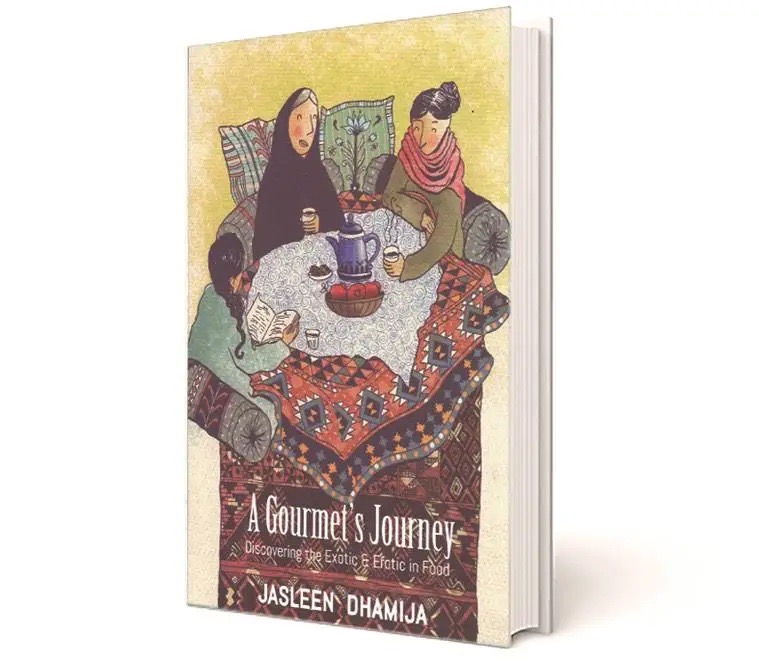
The illustrations in Dhamija’s book are focal and cover situations of eating. These sketches are of waiters at restaurants, people gathered for picnics in a park and the view of the Alps. They attest to Dhamija’s own global adventures of eating at a variety of places. Together these illustrations and sketches discuss processes of eating than just include beautiful and aspirational images of food. This attention to eating as an act, situated in encounter and pleasure unsettles the idea of cuisine, something that is stable, continuous, and sentimentally tied to home and tradition. Instead food is best understood as an instance of queer materiality which makes unfamiliar places and experiences discoverable as home. The erotic titillation that comes with food, the sensuous and inclusive gastronomic ethos that Dhamija’s book puts forth makes discoverable new ways of being at home in the world where pleasures do not necessarily have to fit the respectable, adult, national and heterosexual order.
Endotes
- In Vibrant Matter Jane Bennet tries to underscore how things act as agents. She simultaneously tries to disrupt the overemphasis on humanist models of thought. She borrows the concept of ‘actant’ from Bruno Latour to speak of ‘things’ as ‘actants’ or as sources of action. Actants, she argues, have enough coherence to produce effects which alter the course of events. Although Bennett has written a fascinating book that seeks to understand how a system of objects operates, it is her ideas on edible matter that are most relevant to the subject at hand. In Chapter 3, titled “Edible Matter”, Bennett seeks to delve into the productive power of food.
- According to Mol, eating comes in versions and a close attention to “situations of eating” has the potential to destabilise hierarchies. One can think of “situations of eating” as scenes where new experiences and identities are formed or in other words, a world comes into being.
- In Conversations with Tim Ingold: Anthropology, Education and Life, Ingold argues this one world is not made of classificatory principles such as diversity, for the latter divides the world into ‘us’ and ‘them’ and the world isn’t “sliced up” into contrasting groups (74). Instead the world is an instance of “ongoing differentiation; it’s about the way in which we continually forge our own sense of who we are in and through our relations with others. It’s about becoming different. That’s where all the creativity of social life is to be found” (Ingold 73).