

In the city of Ahmedabad, where I grew up, food is decidedly queer. Couples gather after hours to wander the streets lined with food stalls, finding the right spot to either collect something to eat in the car or a restaurant just nondescript enough that you’re not recognised. In a city so small, intimacy occurs in these hush-hush ways, mostly around food. There are no bars, of course, so you’re constantly seeking the next new food or coffee spot. In my younger days, I didn’t pay as much attention to the romance around me, but just to the crowds. The city seemed loud, always too proud and self-assured in an obnoxious, dare I say, heteronormative way. As an adult, though, experiencing romance, I understood the fundamentally queer state of seeking food with a lover in the city, particularly in Ahmedabad, where home is not that safe, and neither is the public. You are constantly hiding, yet in the moment you are sharing a plate of egg maggi on the roadside with someone you desire, you are not a part of the city. Not this one, anyhow. You have built a space for yourself where desire, whether for an egg or another person, lives freely. My first enquiry with queer-ing food in India began here.
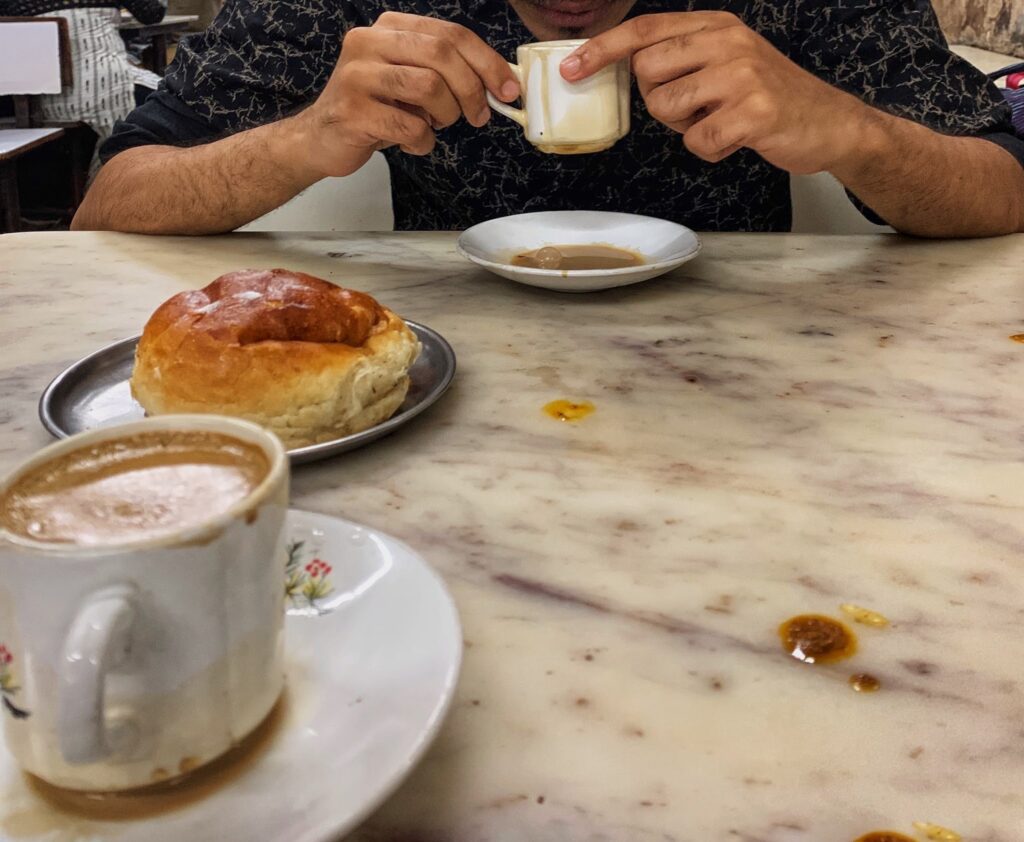
Chai: In Ahmedabad, many relationships happen over chai. Despite 45 degrees of summer heat, the city spills over onto pavements and into chai shops well into the night.
Food is queer because it dismantles
In 2021, I visited a friend, S, in South Delhi when they were setting up a new home. This trip was certainly not my first encounter with queer-ing food, but it cemented my resolve to document the relationship between queerness and food. On my first night in, it rained just as we were preparing a complete Goan meal (chicken Xacuti, fried fish, rice, kismoor, even a kokum cocktail) for a housewarming party, and then the electricity went out. We arranged the decor using candles (we did full Diwali, as S said), S draped a sari, and we set up the house for guests we weren’t sure would make it, all in the dark. Not only did everyone make it, but those who previously couldn’t come showed up at the last minute. The rain, gladly, was not wasted.
We fried the fish ready-to-serve, and mixed the cocktail in a large steel bartan. I’ll never forget what S said after everyone showed up drenched, having walked from metro stations and fought for rickshaws: “You tell the queers you’ve cooked them food, no matter what, they’ll show up.” In that moment, as I looked around at their home, assembled from fragments of earlier lives, and at the people I was surrounded by, who were either struggling to find housing or were in the midst of another move, I recalled (okay, maybe not then) scholar Gayatri Gopinath’s idea of home in Impossible Desires (2005).
She says that for queer South Asian subjects, “home” (whether the family house, the nation, or the diaspora) is often structured through exclusion, through heteronormativity, respectability, and the demand to fit into reproductive futures. So queerness doesn’t simply leave home; it exposes how fragile and conditional that home already is.
What she offers instead is a way to think about home as improvised, partial, and sometimes fleeting. Rather than a fixed place you return to, it becomes something you assemble in fragments, in moments, in relationships, in spaces that are not officially yours. These are what she calls alternative archives of belonging: not grand or permanent structures, but accumulations of small acts, encounters, and intimacies that hold meaning even if they don’t last. V, who was at the dinner, was on month-number-could-not-keep-count of finding rental accommodation in Delhi as a trans person. Prices were one problem; landlords and brokers refusing them a home was another. They were relying on friends and fundraising for others, never themselves, on Instagram. People would often ask them if they could order them chai and naashta in the absence of the ability to offer a physical home. That night, S and I fried them some fish. They will read this and say, uff, I’ve never needed any help, ya. I know, V, everyone except you is suffering! But for the sake of the article, let me say that what Gopinath says of home for queer people as an alternative archive of belonging, even if fleeting, I’ve seen through the lens of food through these visceral experiences.
When YSK invited us all over after moving to Ahmedabad and setting up their home, I was not expecting the kind of extension of care they offered every time we visited them. On one induction stove, they cooked enough mutton curry to serve six people. Mutton curries are labourious to prepare, more so on an induction stove. I’ve only had mutton prepared by friends twice, and each time I’ve thought that cooking mutton for others is an act of love, like being given hours of someone’s life. On another night, they spent half a day preparing biryani and dessert in a small, toy oven. When they moved into a flat where Jain neighbours were strict about the slightest smell of fish or meat, they defied the social order to cook us sardines in a Goan curry, order us mutton samosas, and just generally keep us fed. It would be too simplistic, too heteronormative, to call this maternal instinct. It is particularly queer, not because someone has to ‘be’ queer by sexuality or gender, but because the state of queerness dismantles the home as a decided method that seeks to exclude. Through these experiences with food, I’ve learnt that food reimagines the home by allowing the possibilities of our senses, not repressing them.
It is also precisely because the home is fleeting that it is unstable. During the same Delhi trip, I visited a bar frequented by friends because it’s usually safe for queer people. When you see it from the outside, it’s a simple, family restaurant and bar, serving Mughlai staples. But upstairs are queer folk from across the city, some on dates, some drifting between groups, some working, some watching. It holds multiple tempos at once. On quieter nights, you could sit with a bad cold, share kebabs and soup and brandy, step out for a smoke, and leave without incident. On others, the room will tighten with too many bodies, too much noise, names slipping past you. The staff doesn’t really intervene; they understand the terms of the place better than anyone. Nothing is announced, but everything is negotiated: the intimacy, desire, risk, and the thin line between them.
Even as the room can shift between cruising ground, dating spot, refuge, plates will arrive, anchoring people to their tables, to each other. When a man nearby kept staring at my friend, trying to place them, to understand their gender, they refused the interaction entirely. Instead, they turned to me, insisting I try the kebabs, ordering more, making sure I ate.
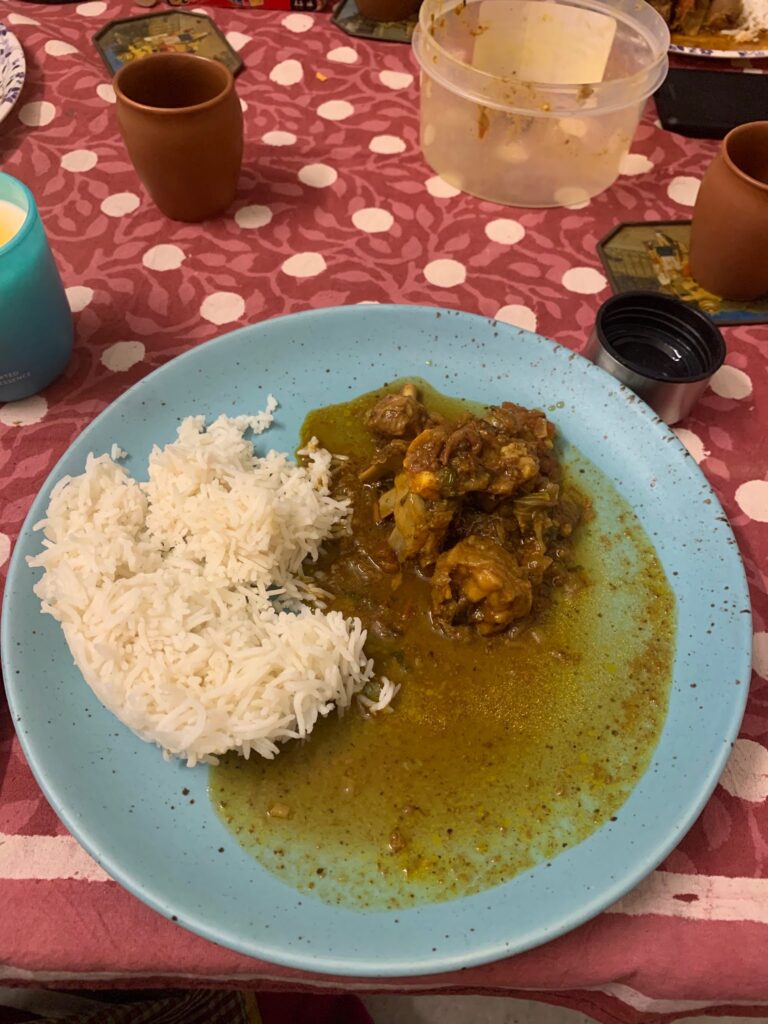
Mutton curry: One of YSK’s many heartfully prepared mutton dishes.
Food is queer because it complicates
This is where the language of “chosen family” begins to feel insufficient. What I was witnessing was not just kinship, but a form of labour, like making mutton curry. It is repetitive, attentive, and often unnoticed. Scholars like Sara Ahmed (2006) argue that comfort is not an inherent quality of space, but an effect of how bodies and environments come into alignment over time. A place feels easy not because it is safe, but because it has been made to accommodate certain ways of being. In that bar, that alignment was constantly being negotiated. Comfort emerged through repetition, the familiar rhythm of ordering, eating, sitting close and returning night after night. Food was part of this circulation. It moved between people, structured interaction, and created small pockets of ease within a space that was not necessarily secure. What felt like safety, then, was not guaranteed, but momentarily produced, held together through acts that had to be repeated to last. At the same time, as Gopinath reminds us, these spaces are never outside power; they are improvised within it. The same room that offered anonymity and intimacy could also produce scrutiny, discomfort, or even threat. I was told by my friends that the bar, too, had incidents where waiters would make queer people feel unsafe. If home is not given, it has to be enacted.
In 2023, I worked on a long-form reported piece called The Very Queer Cookery of Food in India for Queerbeat Media. I started the piece with a single story in mind, a trans kitchen in Chennai I remembered reading about during the Covid-19 pandemic because the woman who ran it was murdered. I hadn’t heard anything since, and tracking it down was a herculean task. I found out later that the kitchen I was looking for might not be in Chennai at all. Still, I reached Chennai and found another trans kitchen to visit. I’d never been to the city before, though my mother grew up there and knew the language. The women at Chennai Trans Kitchen (CTK) were initially awkward with me, but when I brought my mother as a translator to put them at ease, they were able to speak freely about the conditions of their survival in the city and the work they do. The first thing I noticed upon entering Chennai was the number of Biryani street vendors lined up on every turn. It was the afternoon, and despite the haphazard rain, people crowded around the large vats of rice and meat and gorged on the food with their hands.
The women at CTK, too, specialised in Biryani. I asked them if there was more to this fascination with the dish in Chennai, and they found that, as something which is prepared en masse, inexpensive and filling, it is a good meal for the working class. The women, when explaining why they haven’t faced many objections from neighbouring stall owners or customers, said it was because they were not involved in sex work or begging, and were feeding the common man, that people viewed them as respectable. In a context where trans livelihoods are often judged through moral hierarchies, as anthropologist Gayatri Reddy discusses in With Respect to Sex: Negotiating Hijra Identity in South India (2005), what one does in public shapes how one is allowed to exist there. Cooking, unlike other forms of labour available to trans women, is immediately legible as service, care, and work that does not threaten. At the same time, as scholars of gender like Leela Dube (1988) have argued, feeding others is central to how femininity itself is recognised. To cook is to be seen as nurturing, maternal, and respectable. In preparing biryani for a working-class crowd, the women at CTK were inhabiting a role society already knows how to receive. Food, then, allowed them a form of kinship with the world that might otherwise remain out of reach. Food allowed them a kinship with the world they wouldn’t have otherwise.
Food is queer because it disrupts
Of course, structures of kinship are further complicated through caste. As Kancha Ilaiah Shepherd (2009) argues, food in India has long been structured through caste, through distinctions between purity and labour, between those who consume and those who prepare. To cook meat in public, and to feed others through that labour, is never just about sustenance; it is to enter a system already organised by hierarchy and to negotiate one’s place within it. What, then, does it mean for those already positioned outside respectability-trans women, queer people, migrants, to cook within this system? Not to inherit it, but to work within and against it at once. The kitchen at CTK does not disrupt caste, but it rearranges its terms. The women cook meat in public, feed a working-class crowd, and are read through a familiar logic of care. In doing so, they move, however provisionally, from bodies marked as excessive or disruptive to bodies that sustain. This shift is neither complete nor secure. It depends on repetition: showing up, cooking the next day again, and continuing to feed.
Dalit writers like Bama (2000) and Baby Kamble (2008) have long written about food not as comfort but as labour, scarcity, and survival. Something managed under constraint rather than freely given. If, as Kancha Ilaiah Shepherd argues, food in India is already structured through caste and social relations, then what queer and trans kitchens do is not step outside this system, but enter it differently. They cook, they feed, and in doing so, they negotiate a place within a hierarchy that was never meant to include them. When I finally launched my personal documentation project, an Instagram page called Queer-ing Food in India, one of the posts I wrote was on fish and caste: In India, fish occupies a curious space, marked by caste. Neither fully meat, nor fully acceptable. Unlike mutton or beef, fish is often dismissed not just for its violence but for its smell, its mess, its association with working-class, coastal, Dalit, and minority communities. Recently, a scholar at a South Asian university was expelled after tensions over fish curry served on a Hindu fasting day. From monsoon fishing bans to housing societies forbidding its cooking, the politics of purity clings tightly to the plate. For me, a fish thali is a joyful, sensorial rebellion. It’s food that demands hands, invites mess, resists polish. Each person has their own way of navigating bone and spice. To share fish is to share pleasure, play, and heritage. It queers the table by refusing hygiene, order, or silence; reminding us that desire is never neat, and belonging is often built in the mess of eating.
This post was a part of a series I called Eating Architecture, after the book Eating Architecture (2004), where I sought to examine the act of eating as design language, since eating, cooking and serving are all spatial acts. I wanted to make connections between the theoretical work of the authors, who frame eating as an event governed by ritual, law, habit and power, and queerness. Architecture is not just walls, they argue. It’s who sits where, who serves, who waits and who eats last. In India, this is especially caste-coded. During a trip to Vizag, I was visiting the family of a national award-winning craftsman, and they insisted we stay for lunch. As guests, we were to be served first, along with the head of the family, but the son and wife graciously waited and served us. We had never experienced this before and kept insisting they eat with us, but quickly learnt that even if we weren’t there, the male head of the family would eat first, his hands washed, then the others would commence. I thought about the meals I’d had with friends: sitting on the floor, feeding each other, one person eating more than the other, then everyone ordering ice cream. To queer the table is thus to disrupt its design.
When my friend M and I, who is in another country, have our my-morning-their-night chats, we exchange food tips here and there. When they first moved, they were figuring out how to live by themselves for the first time. Growing up, they were not involved in the kitchen as much. So, quite literally, they started from scratch. Our long-distance friendship consisted of catching up over watching them cook and helping them figure out what they should have for breakfast. We’d whip something up from whatever they had in their pantry, sometimes creating something entirely new.
Across the moments I return to, Ahmedabad streets, S’s darkened home in Delhi, the bar where plates anchor people to each other, the kitchen in Chennai where biryani is prepared in bulk, food keeps doing something that exceeds these structures. It does not dismantle them entirely, but it loosens them. It creates brief alignments, small permissions, and ways of staying.
I think again of that plate of egg maggi on a roadside in Ahmedabad. Of sitting in a parked car, or standing by a stall, holding a paper plate too hot to touch, eating quickly before someone sees. Nothing about that moment is secure. The city has not changed. The risks remain. And yet, in that act of sharing food, something shifts. The space becomes usable, if only for a while.
If home is not given, it is assembled. If kinship is not guaranteed, it is enacted. And if food is queer, it is not because it exists outside power, but because it moves through it – quietly, repeatedly, insistently -making room where there was none, even if only for the duration of a meal.
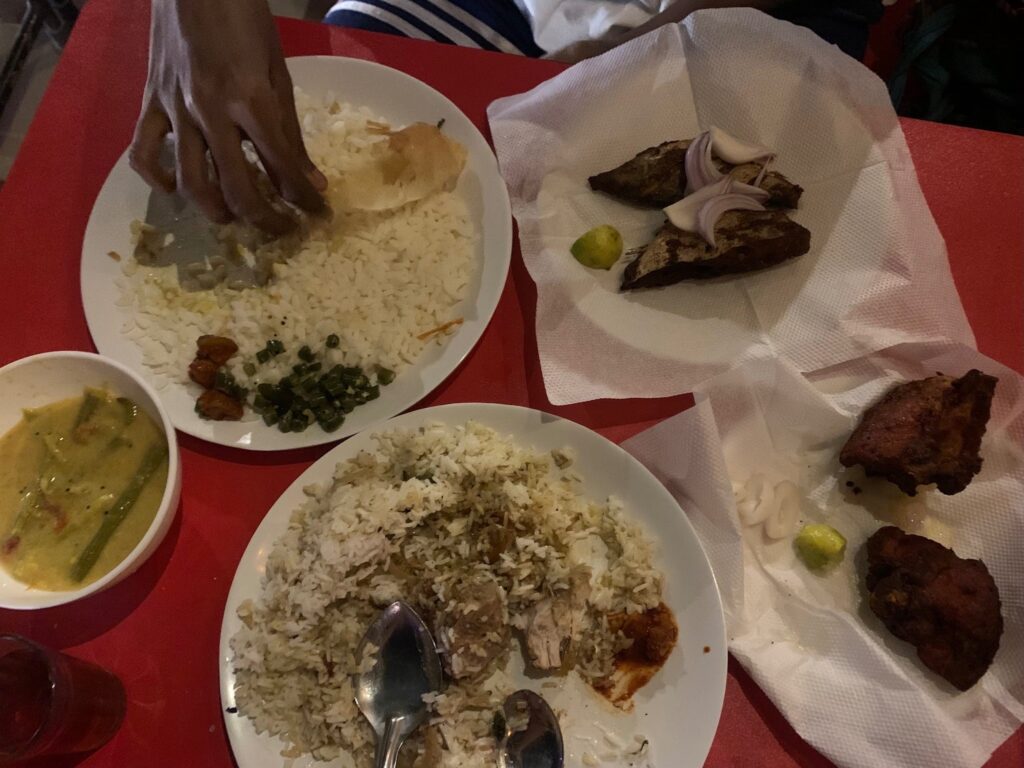
KL: For a few glorious years, a nondescript cafe near the National Institute of Design in Ahmedabad served the students (and us) a rare combination for the city, non-veg Kerala food. Not knowing how long the oasis would last, we spent our evenings devouring fish and mutton. The cafe experienced multiple break-ins by the municipal corporation and had to restart operations time and again. Alas, ultimately, it shut down.