

Notes on Being Eaten: Linguistic Cannibalism, Fatness and the Logic of Consumption
- Rajanya Dey
‘Ma’am, you look good enough to eat,’ was a statement made by someone I once knew. There were other compliments that followed every time I shared a picture. ‘I just dropped my phone trying to lick you through the screen’ was another quite visual one. More graphic compliments have on occasion followed that made me wonder whether he really was imagining me or a plate of khameeri roti and chicken changezi which used to be his apparent favourite meal. I had jokingly started remarking that they viewed me less as a person and more as food to be consumed, to which they sagely agreed — perhaps more honestly than they intended. I would go so far as to say that lovers have always tried to consume each other in more ways than one. But what unsettled me, upon reflection, was not the desire itself but the grammar of it: the woman as object of consumption, the man as appetite to be satisfied. This was not merely the idiolect of my admirer. It reflected the deep structure of a culture in which the female body is routinely figured as ‘meat’ which is available and appetising. And if the erotic vocabulary of heterosexual desire borrows so freely from the language of eating, it is because both operate along the same axis of power: the one who consumes, and the one who is consumed.
The vocabulary of heterosexual desire has always borrowed freely from the language of eating. Roland Barthes in mapping the figures of the lover’s discourse, identifies “Devoration” as one of its central impulses: the lover wishes to consume the beloved, to incorporate them, to close the distance between self and other through an act that is at once erotic and alimentary. “I want to eat you,” Barthes writes, is the lover’s deepest wish. The compliment “good enough to eat” reveals, then, does not perhaps reveal the eccentricity of one admirer but the ready-made language of a whole discourse: a pre-formed figure that the speaker reaches for without reflection, precisely because it is already there, already culturally legible. As the argument on sexuality in popular culture followed, I made my reflections clear to him to which he replied that he had not thought of it that way. The naturalisation of the image of the woman as ‘consumed’ did not even lead him to question the premise. What utterly triggered me was the mental imagery of myself served on a dinner plate somewhere which he had meant to polish off. For, the feminist inside me was demanding an explanation while the excitement of being desirable was strange at the same time. My inner self would go on to ask, ‘To be desired then perhaps is to be consumed?’
But what Barthes describes is a mutual hunger. What his framework doesn’t fully account for is the asymmetry i.e. the question of who, structurally, is positioned as the consumer and who as the consumed. In the exchange I described, I was never the one doing the eating. The compliments moved in one direction only. Interestingly, they expressed a wish to be consumed in return and yet the reduction of a whole person to the status of food, even symmetrically offered, struck me as less a compliment than a category error. I was being appreciated, yes, but as sustenance rather than as subject. This is not merely a quirk of one exchange but summarizes the range of multiple exchanges within the same argument. Hunger, it turns out, is not a gender-neutral phenomenon. Materially, women’s relationship to hunger is fraught with a politics that the erotic register only partially illuminates — as UN Women starkly notes, “Hunger has a woman’s face.” Culturally, this translates into a discourse of thinness, restraint, and appetite-management: what women may eat, how much, and with what degree of visible pleasure. Hunger, whether it is physical, intellectual, or erotic is to be mediated for women. Perhaps my own hesitation at being desired this way stemmed from having been conditioned, long before that conversation, to occupy the position of object rather than subject of appetite.
Carol J. Adams, in The Sexual Politics of Meat, provides a structural name for this asymmetry. Her concept of the ‘absent referent’ describes the process by which both women and animals are rendered consumable through the disappearance of their subjecthood. The animal becomes meat, the woman becomes body, and in both cases what is suppressed is the living, desiring self that preceded the reduction. The overlapping oppressions of women and animals share a logic, the logic of the consumable other, whose transformation into object is the precondition for someone else’s satisfaction. Angela Carter interprets this grammar of desire in the gothic flesh. In The Bloody Chamber, the Marquis does not only desire his young bride but he has already, in some sense, eaten her before the marriage is consummated. The red mark at her throat, the locked room full of previous wives preserved in various states of consumption, the camera-like gaze that renders her an image before she is a person are all visual representations of Adams theorization: that the logic of meat and the logic of male desire operate through the same mechanisms of objectification, possession, and the violent erasure of the subject who was there before. The bride is ‘good’ enough to eat. Adams also refers to the hyper-feminine articulation and the sexualized representation of animated female animals in the American media through the Playboy Bunnies or Pamela Anderson’s PETA advertisements. The argument therefore is that carnivorousness becomes intrinsic to hegemonic masculinity in the way that vegetarianism is to feminine value. Interestingly, the individual in question had a unique relationship to vegetarianism. While primarily a non-vegetarian, he observed vegetarianism only on significant religious occasions, moments when his austerity and restraint became markers of goodness and obedience. That vegetarianism, in other words, was not an ethical or political position but a performance of virtue, structurally feminine in Adams’ terms: the temporary suppression of appetite as proof of moral worth. They could move between carnivore and herbivore positions at will, while I remained in his mind, quite fixed as the object of consumption regardless.
For a plus-sized woman, my individual relationship to food has always been tainted with terms such as ‘healthy’, ‘fat-loss’, ‘control’, ‘dieting’ and so forth. For a long time, I was culturally conditioned to believe that fat women (I am one) were quite unappealing. The representations of heroines in English movies, the romping item numbers of Bollywood had me convinced that I was categorically unattractive. So much of my childhood and young adulthood was thus spent in unceremonious diets, bad bouts of badminton, yoga and physical exercise in an effort to ‘healthify’ me. My poor parents having the best of intentions did quite a number on my self-esteem. So poor was my self-perception that I convinced myself that no man would ever want me. (I don’t know this girl) I had thoroughly internalized the logic Susan Orbach describes in ‘Fat Is A Feminist Issue’: the fat woman is not consumable, therefore she is nothing. Read alongside Adams, this means that the ideal consumable woman is the contained woman, the woman who has already internalized the demand to shrink, then fat is the absent referent made ungovernable. The body that will not be reduced to meat because it refuses the first condition of meatness, which is the disappearance of the self into an object of someone else’s appetite. What I had not anticipated was that the market, ever adaptive, would find a way to consume me anyway. When I first began my overtures into online dating, I had quite the experience. Apparently, ‘thick thighed baddies’ were all the rage now. I found my DMs swimmingly full of men who thought I was quite a ‘treat’(no pun intended). I selected one among the multitudes and it seemed like an exciting prospect that I was also desired for being plus-sized despite being one. Apparently, the idea of having a baddie on your arms, sent starving men to the gym! Here was a man, ready to consume me for all of myself. Even when the inner feminist raged, I began to understand the politics of desire were not simple at all. In fact, belonging to a niche subgroup of the ‘plus-sized baddie’ had deeper political implications. The fat body had not escaped the logic of consumption either, it had been repackaged to look more attractive.
And yet. Something shifted. The language of consumption had opened my mind to a broader field of inquiry within feminist literature itself. Though the man in question has taken his leave from my DMs, he did provide ample material for me to analyze. This operates on two levels. First, it being my primary encounter with male desire taught me the linguistics of sexuality. Secondly, it brought me to examine the grey area where the feminist in me rages and the woman in me remains strangely excited. To exist as both the object of desire and to intellectualize it later is heady. Most importantly, the man who thought I was a treat had, without meaning to, handed me a question I had not known to ask: what was I hungry for? Not what was permissible, not what was appropriate, not what could be consumed without guilt or comment, but what did I actually want? It is a deceptively simple question and a surprisingly difficult one for a woman who had spent the better part of two decades managing her appetite into invisibility. I had been so thoroughly positioned as the object of someone else’s hunger that my own had gone unexamined, unnamed, quietly starved. The exchange that had begun this essay — ‘you look good enough to eat’ was something I now understood differently. The problem was not the desire. The problem was the singular direction of it and in the fact that I was always the meal. It had not occurred to either of us that I might also be hungry.
What does it mean, then, for a woman to claim her appetite, ‘erotic’, ‘intellectual’, ‘physical’ as her own? Orbach suggests that the fat woman’s body is already a refusal, a demand for space that the culture has not granted her. Adams suggests that to exit the position of the consumed is to refuse the logic of ‘meatiness’ altogether, to insist on subjecthood where the culture has installed an object. Does this mean that I objectified him in reverse? No, I did not. I understood that being ‘desired’ wasn’t always linear. I read more about it, I in fact am writing about it without shame. Linguistic cannibalism as a cornerstone of romance made me want to think of a radical way in which the ‘predator-prey’ model does not exist in heterosexual context. This essay is too limited to speculate on it but perhaps it can be a starting point. Carter’s bride survived the Marquis not by becoming palatable but by becoming dangerous. I consumed the compliments voraciously when it was offered the next time, objected when I felt it crossed a line and perhaps tried to create a space for an encounter that wasn’t inherently consuming. One could say, I tried to eat his assumptions on my own terms. Unfortunately, the dialogue did not go on long enough. Perhaps this is what appetite looks like when it is finally allowed to be a woman’s own: not the tidy consumption of what is offered, not the grateful receipt of being desired, but something more ungovernable. A hunger that does not wait to be named by someone else. That does not present itself decorously for another’s satisfaction. The woman who is good enough to eat, it turns out, has always had teeth!
Adams, Carol J. The Sexual Politics of Meat: A Feminist-Vegetarian Critical Theory. Continuum, 1990.
Barthes, Roland. A Lover’s Discourse: Fragments. Translated by Richard Howard, Hill and Wang, 1978.
Carter, Angela. The Bloody Chamber and Other Stories. Gollancz, 1979.
Orbach, Susie. Fat is a Feminist Issue. Paddington Press, 1978.
UN Women. “Hunger Has a Woman’s Face.” UN Women, www.unwomen.org. Accessed 30 Apr. 2026.
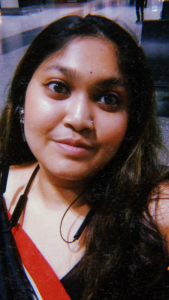
- Rajanya Dey
Rajanya Dey is a 3rd year student of Sociology at Jadavpur University. Her research interests range include feminist theory and praxis, food studies, gender studies and literary studies. Even though she belongs to the discipline of sociology, she strongly believes in interdisciplinary research that involves multiple perspectives.